Teaching the behavior of superalloys at high temperature using model metals for easier test conditions
Use of pure lead to visualize tensile creep deformation
Avainsanat:
mechanical practical works, high temperature tensile creep of superalloys, lead as model alloy, tests at room temperature, law’s exponent, law’s constants, activation energyAbstrakti
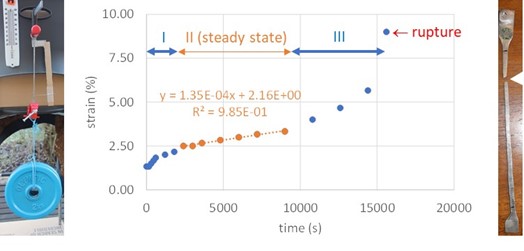
Creep deformation is an important phenomenon leading to failure for high-temperature working components present in aeroengines, combustion turbines or industrial shaping tools. When it has occurred in traction, it is composed of three successive steps. It can be useful, for students in Master of Materials or Metallurgy, to practically observe these three steps of progression of creep deformation. Investigating the dependence of the steady state deformation on temperature and on the applied stress is also of high practical interest. Unfortunately, very high temperature tests imply the use of expensive experimental means as well as severe safety conditions to respect. In this article the illustration of the high temperature creep of highly alloyed steels and superalloys is experimented using lead and a simple and cheap material. The test bench to use can be also very simple and it is even possible to assemble with items that everybody can find at home! It is demonstrated that lead, room temperature, centimetric samples easy to prepare, and several kilograms hung are enough to clearly observe the three stages of creep as well as the final rupture, and this in the classical duration of practical works (e.g. 4 hours) thanks to a wise choice of the stress for a given temperature. Furthermore, specifying the steady state creep rate for several (temperature, stress) couples allows estimating the values of the constants present in the laws of dependence of the secondary creep rate on both stress and temperature. This helps to better understand the Larson-Miller method.
Tiedostolataukset
Julkaistu
Viittaaminen
Numero
Osasto
URN
Lisenssi
Copyright (c) 2026 Patrice Berthod, Quentin Berthod

Tämä työ on lisensoitu Creative Commons Nimeä 4.0 Kansainvälinen Julkinen -lisenssillä.