
Paired peer tutoring in higher chemistry education
The tutors’ experiences of the tutoring
DOI:
https://doi.org/10.31129/LUMAT.13.1.2770Keywords:
first-year students, chemistry, paired peer tutoring, higher educationAbstract
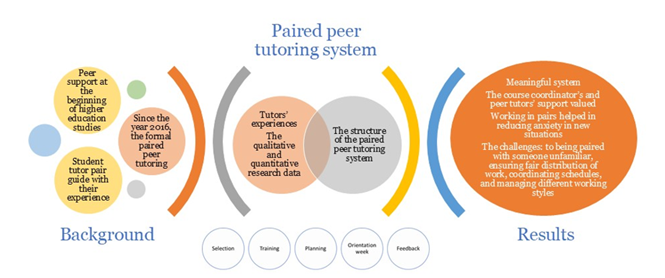
In university education, peer tutoring at the beginning of higher education studies is an important support factor that influences first-year students’ overall experience. Since the year 2016, the formal paired peer tutoring in new students’ orientation has been used in chemistry education at University of Jyväskylä. In this system, a pair of student tutors guides a group of first-year students, using their own experience to help them overcome the challenges of the first weeks at university. The present study examines tutors’ experiences of paired peer tutoring and introduces the structure of the tutoring system. The qualitative and quantitative research data was gathered from 39 tutors using questionnaires from the fall semester 2018 to 2022. Data was analyzed using content analysis and statistical methods. Tutors reported that paired tutoring has been meaningful for them (mean 4,8, a 5-point Likert scale). The course coordinator’s and peer tutors’ support were valued during the tutoring process. Tutors noted that working in pairs was particularly helpful in reducing anxiety in new situations and in resolving challenging circumstances. The main challenges of paired tutoring were related to being paired with someone unfamiliar, ensuring fair distribution of work, coordinating schedules, and managing different working styles.
References
Abbot, S., Graf, A. J., & Chatfield, B. (2018). Listening to Undergraduate Peer Tutors: Roles, Relationships, and Challenges. International Journal of Teaching and Learning in Higher Education, 30(2), 245–261.
Budge, S. (2006). Peer Mentoring in Postsecondary Education: Implications for Research and Practice. Journal of College Reading and Learning, 37(1), 71–85. https://doi.org/10.1080/10790195.2006.10850194 DOI: https://doi.org/10.1080/10790195.2006.10850194
Burgess, A., Dornan, T., Clarke, A. J., Menezes, A., & Mellis, C. (2016). Peer tutoring in a medical school: Perceptions of tutors and tutees. BMC Medical Education, 16(1), 85. https://doi.org/10.1186/s12909-016-0589-1 DOI: https://doi.org/10.1186/s12909-016-0589-1
Colvin, J. W., & Ashman, M. (2010). Roles, Risks, and Benefits of Peer Mentoring Relationships in Higher Education. Mentoring & Tutoring: Partnership in Learning, 18(2), 121–134. https://doi.org/10.1080/13611261003678879 DOI: https://doi.org/10.1080/13611261003678879
De Klerk, D., Krull, G., & Maleswena, T. (2021). Rapid Orientation of Students for Emergency Remote Learning during the Covid‑19 Lockdown. Journal for Students Affairs in Africa, 9(1), 61–76. https://doi.org/10.24085/jsaa.v9i1.1428 DOI: https://doi.org/10.24085/jsaa.v9i1.1428
Falchikov, N. (2003). Learning Together: Peer Tutoring in Higher Education (0 edn). Routledge. https://doi.org/10.4324/9780203451496 DOI: https://doi.org/10.4324/9780203451496
Ghenghesh, P. (2018). Personal tutoring from the perspectives of tutors and tutees. Journal of Further and Higher Education, 42(4), 570–584. https://doi.org/10.1080/0309877X.2017.1301409 DOI: https://doi.org/10.1080/0309877X.2017.1301409
Honkimäki, S., & Tynjälä, P. (2018). Prerequisites for the successful group mentoring of first-year university students: A case study. Mentoring & Tutoring: Partnership in Learning, 26(2), 148–164. https://doi.org/10.1080/13611267.2018.1471338 DOI: https://doi.org/10.1080/13611267.2018.1471338
Kim, M. M. (2015). PEER TUTORING at Colleges and Universities. College and University, 90(4), 2–7. ProQuest Central; Social Science Premium Collection.
Leidenfrost, B., Strassnig, B., Schütz, M., Carbon, C.-C., & Schabmann, A. (2014). The Impact of Peer Mentoring on Mentee Academic Performance: Is Any Mentoring Style Better than No Mentoring at All? International Journal of Teaching and Learning in Higher Education, 26(1), 102–111.
Patton, M. Q. (2010). Qualitative research & evaluation methods (3. ed., [Nachdr.]). Sage.
Pérez-Jorge, D., Rodríguez-Jiménez, M. D. C., Ariño-Mateo, E., & Barragán-Medero, F. (2020). The Effect of COVID-19 in University Tutoring Models. Sustainability, 12(20), 8631. https://doi.org/10.3390/su12208631 DOI: https://doi.org/10.3390/su12208631
Skaniakos, T., Penttinen, L., & Lairio, M. (2014). Peer Group Mentoring Programmes in Finnish Higher Education––Mentors’ Perspectives. Mentoring & Tutoring: Partnership in Learning, 22(1), 74–86. https://doi.org/10.1080/13611267.2014.882609 DOI: https://doi.org/10.1080/13611267.2014.882609
Sun, Y., Lin, S.-Y., & Chung, K. K. H. (2020). University Students’ Perceived Peer Support and Experienced Depressive Symptoms during the COVID-19 Pandemic: The Mediating Role of Emotional Well-Being. International Journal of Environmental Research and Public Health, 17(24), 9308. https://doi.org/10.3390/ijerph17249308 DOI: https://doi.org/10.3390/ijerph17249308
Thurston, A., Cockerill, M., & Chiang, T.-H. (2021). Assessing the Differential Effects of Peer Tutoring for Tutors and Tutees. Education Sciences, 11(3), 97. https://doi.org/10.3390/educsci11030097 DOI: https://doi.org/10.3390/educsci11030097
Topping, K. J. (1996). The effectiveness of peer tutoring in further and higher education: A typology and review of the literature. Higher Education, 32(3), 321–345. https://doi.org/10.1007/BF00138870 DOI: https://doi.org/10.1007/BF00138870
Tuomi, J., & Sarajärvi, A. (2018). Laadullinen tutkimus ja sisällönanalyysi. Tammi.
Valto, P., & Nuora, P. (2019). The role of guidance in student engagement with chemistry studies. Lumat: International Journal of Math, Science and Technology Education, 7(1). https://doi.org/10.31129/LUMAT.7.1.402 DOI: https://doi.org/10.31129/LUMAT.7.1.402
Van Maaren, J., Jensen, M., & Foster, A. (2022). Tutoring in Higher Education during COVID-19: Lessons from a Private University’s Transition to Remote Learning. Journal of College Reading and Learning, 52(1), 3–22. https://doi.org/10.1080/10790195.2021.2007175 DOI: https://doi.org/10.1080/10790195.2021.2007175
Velasco, J. B., & Stains, M. (2015). Exploring the relationships between perceptions of tutoring and tutoring behaviours: A focus on graduate students serving as peer tutors to college-level chemistry students. Chemistry Education Research and Practice, 16(4), 856–868. https://doi.org/10.1039/C5RP00103J DOI: https://doi.org/10.1039/C5RP00103J
Wilcox, P., Winn, S., & Fyvie‐Gauld, M. (2005). ‘It was nothing to do with the university, it was just the people’: The role of social support in the first‐year experience of higher education. Studies in Higher Education, 30(6), 707–722. https://doi.org/10.1080/03075070500340036 DOI: https://doi.org/10.1080/03075070500340036
Wilson, W. L., & Arendale, D. R. (2011). Peer educators in learning assistance programs: Best practices for new programs. New Directions for Student Services, 2011(133), 41–53. https://doi.org/10.1002/ss.383 DOI: https://doi.org/10.1002/ss.383
Wong, W. H., & Chapman, E. (2023). Student satisfaction and interaction in higher education. Higher Education, 85(5), 957–978. https://doi.org/10.1007/s10734-022-00874-0 DOI: https://doi.org/10.1007/s10734-022-00874-0
Yale, A. T. (2019). The personal tutor–student relationship: Student expectations and experiences of personal tutoring in higher education. Journal of Further and Higher Education, 43(4), 533–544. https://doi.org/10.1080/0309877X.2017.1377164 DOI: https://doi.org/10.1080/0309877X.2017.1377164
Yin, R. (2009). Case study research: Design and methods (4th Ed.). Sage.
Yook, E. L., & Kim, M. M. (2013). Reflecting on Assessment Results to Inform Communication Center Tutor Training and Hiring. Journal of Assessment and Institutional Effectiveness, 3(2), 140–156. https://doi.org/10.5325/jasseinsteffe.3.2.0140 DOI: https://doi.org/10.5325/jasseinsteffe.3.2.0140
Downloads
Published
How to Cite
License
Copyright (c) 2025 Piia Valto, Piia Nuora

This work is licensed under a Creative Commons Attribution 4.0 International License.