
Exploring Students' Scientific Reasoning During Virtual Game in STEAM Problem Solving
DOI:
https://doi.org/10.31129/LUMAT.13.3.2795Keywords:
Multivariate analysis, Virtual interactive simulation, STEM education, Scientific reasoning, Problem solvingAbstract
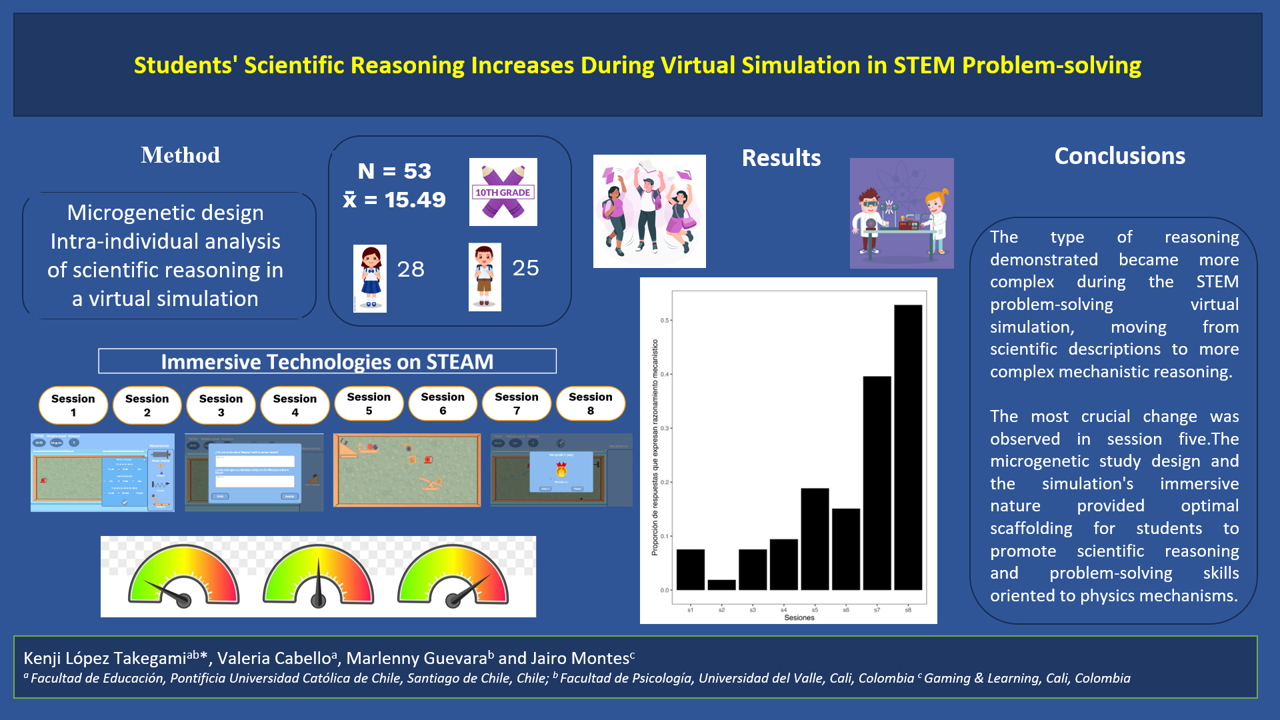
The purpose of this study was to explore the complexity of scientific reasoning elicited during a virtual STEAM problem-solving activity by challenging questions posed to 53 tenth-grade high school students. Using a microgenetic approach, this study analyzed eight measurements from each student as they worked on a STEAM problem-solving game software, utilizing it as an interactive simulation. To measure the complexity of their scientific reasoning, researchers used a coding rubric based on the cognitive demand of questions that were self-administered through the interactive simulation. Multivariate analysis showed that the students’ level of scientific reasoning complexity increased over time, shifting from descriptive reasoning in the early sessions to more complex causal reasoning in the final sessions. It is possible to interpret that this sophistication in scientific reasoning may be related to three points: 1) The demand for practical scientific knowledge regarding the virtual interactive simulation when solving the problem, 2) The challenging questions presented in the situation, and 3) The immersive nature not only of the simulation itself, but also of the repeated measures design of this science education activity. We discuss about the type of reasoning observed, progressively becoming more complex, and the transitions between lower to higher scores as a means of an ongoing process of learning opportunities for developing students’ scientific reasoning in a virtual interactive simulation. Interaction with the designed game allowed students' scientific reasoning to increase progressively over the eight observation sessions.
References
Ahmad, A. R., Chew, F. P., Zulnaidi, H., Sobri, K. M., & Alfitri. (2019). Influence of School Culture and Classroom Environment in Improving Soft Skills amongst Secondary Schoolers. International Journal of Instruction, 12(2), 259–274. https://doi.org/10.29333/iji.2019.12217a DOI: https://doi.org/10.29333/iji.2019.12217a
Alanazi, A., Osman, K., & Halim, L. (2024). Enhancing physics problem-solving skills through guided discovery and scaffolding strategies: Evidence from Saudi technical colleges. LUMAT: International Journal on Math, Science and Technology Education, 12(4), Article 4. https://doi.org/10.31129/LUMAT.12.4.2329 DOI: https://doi.org/10.31129/LUMAT.12.4.2329
Alderete, M. V., Di Meglio, G., & Formichella, M. M. (2017). Acceso a las TIC y rendimiento educativo: ¿una relación potenciada por su uso? Un análisis para España. Revista de Educación, 377. https://doi.org/10.4438/1988-592X-RE-2017-377-353
Asale, T. S. (2017). Teachers’ Perception and Practices Towards Continuous Assessment of Mathematics Classes: The Case of Secondary School in Wolaita Zone, Snnpr Region.
Barbera, E. (2004). Quality in virtual education environments. British Journal of Educational Technology, 35(1), 13–20. https://doi.org/10.1111/j.1467-8535.2004.00364.x DOI: https://doi.org/10.1111/j.1467-8535.2004.00364.x
Bargallo, C. M., & Tort, M. R. (2006). Plantear preguntas: Un punto de partida para aprender ciencias. Revista Educación y Pedagogía, 18(45), Article 45.
Bargiela, I. M., Anaya, P. B., & Puig, B. (2022). Las preguntas para la indagación y activación de pensamiento crítico en educación infantil. Enseñanza de las Ciencias. Revista de investigación y experiencias didácticas, 40(3), Article 3. https://doi.org/10.5565/rev/ensciencias.5470 DOI: https://doi.org/10.5565/rev/ensciencias.5470
Beck, D., Morgado, L., & O'Shea, P. (2024). Educational Practices and Strategies with Immersive Learning Environments: Mapping of Reviews for Using the Metaverse. In IEEE Transactions on Learning Technologies, vol. 17, pp. 319–341, 2024, https://doi.org/10.1109/TLT.2023.3243946 DOI: https://doi.org/10.1109/TLT.2023.3243946
Belbase, S., Mainali, B. R., Kasemsukpipat, W., Tairab, H., Gochoo, M., & Jarrah, A. (2021). At the dawn of science, technology, engineering, arts, and mathematics (STEAM) education: prospects, priorities, processes, and problems. International Journal of Mathematical Education in Science and Technology, 53(11), 2919–2955. https://doi.org/10.1080/0020739X.2021.1922943 DOI: https://doi.org/10.1080/0020739X.2021.1922943
Berezi, I. U. (2025). Virtual Learning Environment: Redefining Higher Educational Delivery for Efficiency and Accessibility. International Journal of Educational Management, Rivers State University., 1(1), 451¬¬–467.
Bertrand, M. G., & Namukasa, I. K. (2020). STEAM education: student learning and transferable skills. Journal of Research in Innovative Teaching & Learning 24 June 2020, 13(1): 43–56. https://doi.org/10.1108/JRIT-01-2020-0003 DOI: https://doi.org/10.1108/JRIT-01-2020-0003
Blythe, C., & and Harré, N. (2020). Encouraging transformation and action competence: A Theory of Change evaluation of a sustainability leadership program for high school students. The Journal of Environmental Education, 51(1), 83–96. https://doi.org/10.1080/00958964.2019.1629381 DOI: https://doi.org/10.1080/00958964.2019.1629381
Boytchev, P., & Boytcheva, S. (2020). Gamified Evaluation in STEAM for Higher Education: A Case Study. Information, 11(6), 316. https://doi.org/10.3390/info11060316 DOI: https://doi.org/10.3390/info11060316
Bråten, I., & Braasch, J. L. G. (2017). Key Issues in Research on Students’ Critical Reading and Learning in the 21st Century Information Society. In C. Ng & B. Bartlett (Eds.), Improving Reading and Reading Engagement in the 21st Century: International Research and Innovation (pp. 77–98). Springer. https://doi.org/10.1007/978-981-10-4331-4_4 DOI: https://doi.org/10.1007/978-981-10-4331-4_4
Brown, G. T. L. (2022). The past, present and future of educational assessment: A transdisciplinary perspective. Frontiers in Education, 7. https://doi.org/10.3389/feduc.2022.1060633 DOI: https://doi.org/10.3389/feduc.2022.1060633
Bucarey, C. J., Pérez, S. M., Marín, M. G., & Castillo, L. A. (2023). Brechas en percepción de contribución de competencias genéricas entre estudiantes en Chile. Revista de ciencias sociales, 29(1), 386–403.
Cabello, V. M., Martinez, M. L., Armijo, S., & Maldonado, L. (2021). Promoting STEAM learning in the early years: “Pequeños Científicos” Program. LUMAT: International Journal on Math, Science and Technology Education, 9(2), 33–62. https://doi.org/10.31129/LUMAT.9.2.1401 DOI: https://doi.org/10.31129/LUMAT.9.2.1401
Caspari, I., Weinrich, M. L., Sevian, H., & Graulich, N. (2018). This mechanistic step is “ productive ”: Organic chemistry students’ backward-oriented reasoning. Chemistry Education Research and Practice, 19(1), 42–59. https://doi.org/10.1039/C7RP00124J DOI: https://doi.org/10.1039/C7RP00124J
Castañeda Zapata, E. A., López Ríos, S. Y., & Osorio Vélez, J. A. (2024). Naturaleza de la ciencia para la enseñanza de la relatividad general: Una revisión sistemática. Aula abierta, 53(2), 149–158. DOI: https://doi.org/10.17811/rifie.19960
Castro, P. (2022). Reflexiones sobre la educación STEAM, alternativa para el siglo XXI. Praxis, 18(1), 158–175. DOI: https://doi.org/10.21676/23897856.3762
Cheng, S.-C., She, H.-C., & Huang, L.-Y. (2017). The Impact of Problem-Solving Instruction on Middle School Students’ Physical Science Learning: Interplays of Knowledge, Reasoning, and Problem Solving. EURASIA Journal of Mathematics, Science and Technology Education, 14(3). https://doi.org/10.12973/ejmste/80902 DOI: https://doi.org/10.12973/ejmste/80902
Chin, C. (2007). Teacher questioning in science classrooms: Approaches that stimulate productive thinking. Journal of Research in Science Teaching, 44(6), 815–843. https://doi.org/10.1002/tea.20171 DOI: https://doi.org/10.1002/tea.20171
Conejera, A. R., Joglar, C., & Jara, R. (2020). Promoviendo la Formulación de Buenas Preguntas en la Clase de Biología en Secundaria: Una propuesta didáctica a partir de situaciones problema. Ciência & Educação (Bauru), 26, e20034. https://doi.org/10.1590/1516-731320200034 DOI: https://doi.org/10.1590/1516-731320200034
Dejonckheere, P. J. N., Van De Keere ,Kristof, & and Mestdagh, N. (2009). Training the Scientific Thinking Circle in Pre- and Primary School Children. The Journal of Educational Research, 103(1), 1–16. https://doi.org/10.1080/00220670903228595 DOI: https://doi.org/10.1080/00220670903228595
Dengel, A., & Mägdefrau, J. (2018). Immersive Learning Explored: Subjective and Objective Factors Influencing Learning Outcomes in Immersive Educational Virtual Environments. 2018 IEEE International Conference on Teaching, Assessment, and Learning for Engineering (TALE), 608–615. https://doi.org/10.1109/TALE.2018.8615281 DOI: https://doi.org/10.1109/TALE.2018.8615281
Dhitasarifa, I., & Wusqo, I. U. (2024). The effect of STEAM approach digital teaching materials on increasing creative problem-solving skills. Turkish Online Journal of Distance Education, 25(3), 18–27. https://doi.org/10.17718/tojde.1302079 DOI: https://doi.org/10.17718/tojde.1302079
Domenici, V. (2022). STEAM Project-Based Learning Activities at the Science Museum as an Effective Training for Future Chemistry Teachers. Education Sciences, 12(1), 30. https://doi.org/10.3390/educsci12010030 DOI: https://doi.org/10.3390/educsci12010030
Efremova, N., Shapovalova, O., & Huseynova, A. (2020). Innovative technologies for the formation and assessment of competencies and skills in the XXI century. E3S Web of Conferences, 210, 18021. https://doi.org/10.1051/e3sconf/202021018021 DOI: https://doi.org/10.1051/e3sconf/202021018021
Eshach, H., Dor-Ziderman, Y., & Yefroimsky, Y. (2014). Question Asking in the Science Classroom: Teacher Attitudes and Practices. Journal of Science Education and Technology, 23(1), 67–81. https://doi.org/10.1007/s10956-013-9451-y DOI: https://doi.org/10.1007/s10956-013-9451-y
Feldman, B. J., & Rabe-Hesketh, S. (2012). Modeling Achievement Trajectories When Attrition Is Informative. Journal of Educational and Behavioral Statistics, 37(6), 703–736. https://doi.org/10.3102/1076998612458701 DOI: https://doi.org/10.3102/1076998612458701
Gim, N. (2021). Development of Life Skills Program for Primary School Students: Focus on Entry Programming. Computers, 10(5), Article 5. https://doi.org/10.3390/computers10050056 DOI: https://doi.org/10.3390/computers10050056
Guevara, M., van Dijk, M., & van Geert, P. (2016). Microdevelopment of peer interactions and scientific reasoning in young children / Microdesarrollo de la interacción entre pares y el razonamiento científico en niños pequeños. Journal for the Study of Education and Development, 39(4), 727–771. https://doi.org/10.1080/02103702.2016.1215083 DOI: https://doi.org/10.1080/02103702.2016.1215083
Guzey, S. (2015). The Need for a STEM Road Map Tamara J. Moore, Carla C. Johnson, Erin E. Peters-Burton, and S. STEM Road Map: A Framework for Integrated STEM Education.
Hidri, S. (2019). Static vs. dynamic assessment of students’ writing exams: A comparison of two assessment modes. International Multilingual Research Journal, 13(4), 239–256. https://doi.org/10.1080/19313152.2019.1606875 DOI: https://doi.org/10.1080/19313152.2019.1606875
ICFES (2024). Programa para la Evaluación Internacional de Alumnos (PISA). Informa nacional de resultados para Colombia 2022. Ministerio de Educación Nacional. https://www.mineducacion.gov.co/1780/articles-421217_recurso_03.pdf
Kaur, D. P., Kumar, A., Dutta, R., & Malhotra, S. (2022). The role of interactive and immersive technologies in higher education: A survey. Journal of Engineering Education Transformations, 36(2), 79-86. https://doi.org/10.16920/jeet/2025/v38is2/25001 DOI: https://doi.org/10.16920/jeet/2022/v36i2/22156
Kawalkar, A., & Vijapurkar, J. (2011). Scaffolding Science Talk: The role of teachers’ questions in the inquiry classroom. International Journal of Science Education, 35(12), 2004–2027. https://doi.org/10.1080/09500693.2011.604684 DOI: https://doi.org/10.1080/09500693.2011.604684
Krippendorff, K. (2011). Agreement and Information in the Reliability of Coding. Communication Methods and Measures, 5(2), 93–112. https://doi.org/10.1080/19312458.2011.568376 DOI: https://doi.org/10.1080/19312458.2011.568376
Kumar, B., & Deák, C., (2023). Evolving Minds: A Literature-Driven and Empirical Explorationof STEAM Skill Development and Learning Approaches. Journal of Innovation Management, 11(4), 71–96. https://doi.org/10.24840/2183-0606_011.004_00041 DOI: https://doi.org/10.24840/2183-0606_011.004_0004
Lau, A. M. S. (2016). ‘Formative good, summative bad?’ – A review of the dichotomy in assessment literature. Journal of Further and Higher Education, 40(4), 509–525. https://doi.org/10.1080/0309877X.2014.984600 DOI: https://doi.org/10.1080/0309877X.2014.984600
Lecturer, School of Education, University of New South Wales Sydney, Australia, d.alonzo@unsw.edu.au, Alonzo, D., Loughland, T., & Assoc. Prof., School of Education, University of New South Wales Sydney, Australia, tony.loughland@unsw.edu.au. (2022). Variability of Students’ Responses to Assessment Activities: The Influence of Achievement Levels. International Journal of Instruction, 15(4), 1071–1090. https://doi.org/10.29333/iji.2022.15457a DOI: https://doi.org/10.29333/iji.2022.15457a
Lee, Y., & Kinzie, M. B. (2012). Teacher question and student response with regard to cognition and language use. Instructional Science, 40(6), 857–874. https://doi.org/10.1007/s11251-011-9193-2 DOI: https://doi.org/10.1007/s11251-011-9193-2
López-Aguilar, D., Álvarez-Pérez, P. R., & Garcés-Delgado, Y. (2021). El engagement académico y su incidencia en el rendimiento del alumnado de grado de la Universidad de La Laguna. RELIEVE - Revista Electrónica de Investigación y Evaluación Educativa, 27(1), Article 1. https://doi.org/10.30827/relieve.v27i1.21169 DOI: https://doi.org/10.30827/relieve.v27i1.21169
Manassero-Mas, M., & Vázquez-Alonso, Á. (2020). Pensamiento científico y pensamiento crítico: competencias transversales para aprender. Indagatio Didactica, 12(4), 401-419. https://doi.org/10.34624/id.v12i4.21808
Maraza-Quispe, B., Caytuiro-Silva, N., & Arizaca-Machaca, E. (2022). Sistema de Enseñanza-Aprendizaje inteligente basado en el Razonamiento Basado en Casos. 1(2).
Martínez Villalba, J. A., & Sánchez Muñoz, S. (2018). Generación de Competencias con Base en la Gestión de Conocimiento Científico. REICE. Revista Iberoamericana sobre Calidad, Eficacia y Cambio en Educación. https://doi.org/10.15366/reice2018.16.2.004 DOI: https://doi.org/10.15366/reice2018.16.2.004
McPhail, G. (2018). Curriculum integration in the senior secondary school: A case study in a national assessment context. Journal of Curriculum Studies, 50(1), 56–76. https://doi.org/10.1080/00220272.2017.1386234 DOI: https://doi.org/10.1080/00220272.2017.1386234
Michael, B., & Michael, R. (2019). Show me and I’ll remember: Association between instructional modality and memory for learning. Journal of International Education in Business, 12(1), 95–110. DOI: https://doi.org/10.1108/JIEB-06-2018-0020
Moreira, P., Marzabal, A., & Talanquer, V. (2019). Investigating the effect of teacher mediation on student expressed reasoning. Chemistry Education Research and Practice, 20(3), 606–617. https://doi.org/10.1039/C9RP00075E DOI: https://doi.org/10.1039/C9RP00075E
Nadelson, L. S., & Seifert, A. L. (2017). Integrated STEM defined: Contexts, challenges, and the future. The Journal of Educational Research, 110(3), 221–223. https://doi.org/10.1080/00220671.2017.1289775 DOI: https://doi.org/10.1080/00220671.2017.1289775
Piboon, K., Khlaisang, J., & Koraneekij, P. (2024). Virtual Studio Learning Environment Based on STEAM Education Concept Integrated With Socio-Scientific Issues to Enhance Learner’s Scientific Creativity. Journal of Information and Learning [JIL], 35(2), Article 2.
Prince Torres, Á. C. (2022). El aprendizaje inmersivo como alternativa educativa en contextos de emergencia. Podium, 42, 19–38. https://doi.org/10.31095/podium.2022.42.2 DOI: https://doi.org/10.31095/podium.2022.42.2
Sánchez, Á., Haye, A., & Sebastián, C. (2022). Affective learning as a higher psychological process: A microgenetic analysis of evaluative conditioning from a sociocultural approach (Aprendizaje afectivo como proceso psicológico superior: análisis microgenético del condicionamiento evaluativo desde un enfoque sociocultural). Studies in Psychology, 43(2), 287–310. https://doi.org/10.1080/02109395.2021.1991132 DOI: https://doi.org/10.1080/02109395.2021.1991132
Sánchez, N. M., Lorenzo, M. M. G., & Valdivia, Z. Z. G. (2009). Modelo para diseñar sistemas de enseñanza-aprendizaje inteligentes utilizando el razonamiento basado en casos. Avances en Sistemas e Informática, 6(3), 67–78.
Siegler, R. S., & Crowley, K. (1991). The microgenetic method: A direct means for studying cognitive development. American Psychologist, 46(6), 606–620. https://doi.org/10.1037/0003-066X.46.6.606 DOI: https://doi.org/10.1037//0003-066X.46.6.606
Sommer, M. y Cabello, V. M. (2020) Andamios de retiro gradual. Parte 2: Apoyos a la construcción de explicaciones en ciencia primaria. Estudios Pedagógicos, 46(1), 269–284. http://dx.doi.org/10.4067/S0718-07052020000100269 DOI: https://doi.org/10.4067/S0718-07052020000100269
Soroko,N. (2024). Features of organizing steam educational projects using immersive technologies. Physical and Mathematical Education, 39(2), 51–59. https://doi.org/10.31110/fmo2024.v39i2-07 DOI: https://doi.org/10.31110/fmo2024.v39i2-07
Soto, C., & Natalia, M. (2023). Los ODS como elemento transversal y clave para el cambio hacia una educación de calidad. 1–184. DOI: https://doi.org/10.2307/jj.8500831
Soysal, Y. (2020). Investigating discursive functions and potential cognitive demands of teacher questioning in the science classroom. Learning: Research and Practice, 6(2), 167–194. https://doi.org/10.1080/23735082.2019.1575458 DOI: https://doi.org/10.1080/23735082.2019.1575458
Tort, M. R. (2005). Las preguntas en el proceso de enseñanza- aprendizaje de las ciencias.
Tsankov, N. (2018). The transversal competence for problem-solving in cognitive learning. International Journal of Cognitive Research in Science, Engineering and Education (IJCRSEE), 6(3), 67–82. DOI: https://doi.org/10.5937/ijcrsee1803067T
Utomo D. P., & Santoso T. (2021). Zone of proximal development and scaffolding required by junior high school students in solving mathematical problems. The Education and Science Journal, 23(9): 186–202. https://doi.org/10.17853/1994-5639-2021-9-186-202 DOI: https://doi.org/10.17853/1994-5639-2021-9-186-202
van Vondel, S., Steenbeek, H., van Dijk, M., & van Geert, P. (2017). Ask, don’t tell; A complex dynamic systems approach to improving science education by focusing on the co-construction of scientific understanding. Teaching and Teacher Education, 63, 243–253. https://doi.org/10.1016/j.tate.2016.12.012 DOI: https://doi.org/10.1016/j.tate.2016.12.012
Wu, C. H., Tang, Y. M., Tsang, Y. P., & Chau, K. Y. (2021). Immersive Learning Design for Technology Education: A Soft Systems Methodology. Frontiers in Psychology, 12. https://doi.org/10.3389/fpsyg.2021.745295 DOI: https://doi.org/10.3389/fpsyg.2021.745295
Zeegers, Y., & and Elliott, K. (2019). Who’s asking the questions in classrooms? Exploring teacher practice and student engagement in generating engaging and intellectually challenging questions. Pedagogies: An International Journal, 14(1), 17–32. https://doi.org/10.1080/1554480X.2018.1537186 DOI: https://doi.org/10.1080/1554480X.2018.1537186
Downloads
Published
How to Cite
Issue
Section
Categories
License
Copyright (c) 2025 José Julián Kenji López Takegami, Valeria Cabello, Marlenny Guevara, Jairo Montes

This work is licensed under a Creative Commons Attribution 4.0 International License.