
The use of AI-powered math platforms in mathematics learning
DOI:
https://doi.org/10.31129/LUMAT.14.1.2918Keywords:
artificial intelligence, AI-powered math platforms, mathematics learning, mathematics performance, technology in mathematicsAbstract
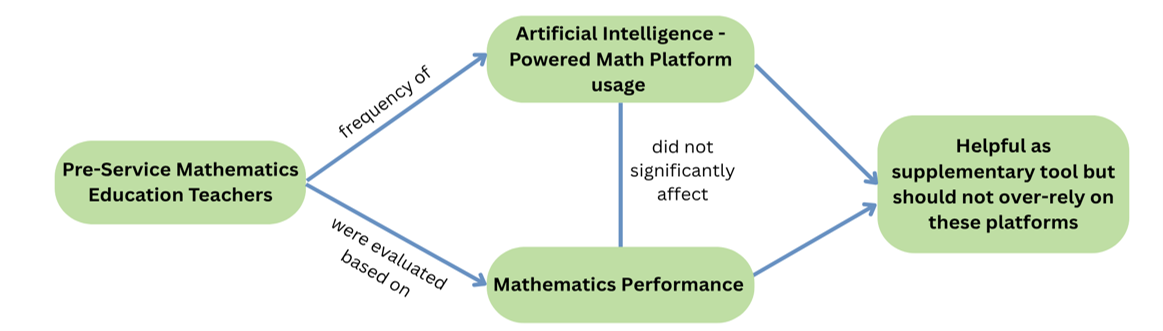
Artificial Intelligence-powered technologies are prevalent today, especially in education. Numerous studies have shown an increasing number of students utilizing AI-powered math platforms (AI-PMPs) as supplementary tools for mathematics learning. However, there is limited information on how these platforms specifically benefit pre-service mathematics education teachers at a public higher education institution. To address the population, knowledge, and theory gap, this study aims to evaluate AI-PMPs and students' experiences using them. By employing a convergent parallel mixed-methods approach, the researchers will explore the relationship between the frequency of AI-PMP usage and the students’ mathematics performance using a correlational quantitative design, and assess the students’ sentiments about AI-PMPs through a descriptive qualitative design. Proportional stratified random sampling was used to select 92 respondents for the quantitative phase, while purposive sampling identified 19 participants for the qualitative phase. Data was gathered through survey questionnaires and one-on-one interviews. The findings revealed that the frequency of AI-PMP usage did not significantly affect students’ mathematics performance, highlighting various purposes, impacts, and challenges associated with these platforms. The study found that while AI-PMPs have an inconsistent effect on mathematics performance, they can serve as useful supplementary tools for enhancing learning. Therefore, it is recommended that students not overly rely on and put limits on using AI-PMPs. The study output was a user guide for the commonly used AI-PMPs.
References
Abar, C. a. a. P., Santos, J. M. D. S. D., & De Almeida, M. V. (2024c). Contributes to the Integration Between Compu-tational Thinking and Artificial Intelligence for Mathematics Education. In Lecture notes in networks and sys-tems (pp. 290–299). https://doi.org/10.1007/978-3-031- 54256-5_27
Almaiah, M. A., Alfaisal, R., Salloum, S. A., Hajjej, F., Shishakly, R., Lutfi, A., Alrawad, M., Mulhem, A. A., Alkhdour, T., & Al-Maroof, R. S. (2022). Measuring Institutions’ Adoption of Artificial Intelligence Applications in Online Learning Environments: Integrating the Innovation Diffusion Theory with Technology Adoption Rate. Electronics, 11(20), 3291. https://doi.org/10.3390/electronics11203291
Bannister et al., (2014). Flexible Conceptions of Perspectives and Representations: An Examination of Pre-Service Mathematics Teachers’ Knowledge. International Journal of Education in Mathematics, Science and Technology: 2(3). https://doi.org/10.18404/ijemst.23592
Blikstein, P. (2018). Exploring Problem-Based Learning for Middle School Design and Engineering Education in Digital Fabrication Laboratories. Interdisciplinary Journal
Bringula et al., (2021). Mathematics Self-Concept and Challenges of Learners in an Online Learning Environment during the COVID-19 Pandemic. Smart Learning Environments, 8(1). https://doi.org/10.1186/s40561-021-00168-5
Chen, L., Zhao, Y., & Parker, E. (2025). The Impact of AI-Powered Adaptive Learning on Student Performance in Undergraduate Mathematics. Frontiers in Humanities and Social Research, 2(3), 378–399. https://sprcopen.org/index.php/fhsr/article/view/424
Cronbach, L. J. (1951). Coefficient alpha and the internal structure of tests. Psychometrika, 16(3), 297–334.doi:10.1007/bf02310555
Dabingaya (2022). Analyzing the effectiveness of AI-Powered Adaptive Learning platforms in mathematics education. Interdisciplinary Journal Papier Human Review, 3(1), 1–7. https://doi.org/10.47667/ijphr.v3i1.226
De Oliveira Andrade, E. A., Da Silva, I. P., & Pina, M. O. M. (2023). DIGITAL TECHNOLOGIES IN MATHEMATICS EDUCATION. Journal of Interdisciplinary Debates, 4(01), 97–122. https://doi.org/10.51249/jid.v4i01.1255
Downes, S.(2005). An introduction to connective knowledge. ResearchGate. https://www.researchgate.net/publication/248290359_An_Introduction_to_Connective_ Knowledge
Efendi, M. A., Panglipur, I. R., & Murtinasari, F. (2024). Identifying the use of artificial intelligence in math learning based on learning outcomes. At- Ta Lim Jurnal Pendidikan, 10(2), 53–59. https://doi.org/10.55210/attalim.v10i2.1689
Galabo, N. R, Abellanosa, G. G., & Gempes, G. P. (2018). The level of readiness in mathematics of first-year high school students of Cluster 6 Tugbok Secondary Schools: Basis for Intervention Program. International Journal of Humanities, Arts and Social Sciences, 4(1). https://doi.org/10.20469/ijhss.4.10005-1
Genckaya & Tan-Sisman (2021). The use of the history of mathematics in teaching-learning process: The perspectives of faculty members and teachers. Psycho-Educational Research Reviews. https://doi.org/10.52963/PERR_Biruni_V10.N2.17
Goldie, J. G. S. (2016). Connectivism: A knowledge learning theory for the digital age? Medical Teacher, 38(10), 1064–1069. https://doi.org/10.3109/0142159x.2016.1173661
Gulliford, A., & Miller, A. (2015). Raising early achievement in Math with A randomized control trial. Journal of Educational Psychology, 111(2), 284–298. https://www.ncbi.nlm.nih.gov/pmc/articles/PMC6366442
Halton, C. (2023, December 14). Diffusion of Innovations Theory: Definition and Examples. Investopedia. https://www.investopedia.com/terms/d/diffusion-of-innovations-theory.asp
Tsai, S. (2024, February 15). Photomath Review 2024. SCI Journal. https://www.scijournal.org/articles/photomath-review
International Mathematics Union (2023). Mathematics in Africa: Challenges and Opportunities. https://www.mathunion.org/fileadmin/CDC/cdcuploads/CDC_MENAO/Africa_Re port.pdf
Johnson, L., Becker, S. A., Cummins, M., Estrada, V., Freeman, A., & Hall, C. (2016, February 1). NMC Horizon Report: 2016 Higher Education Edition. Learning & Technology Library (LearnTechLib). https://www.learntechlib.org/p/171478/
Kanvaria, V. K., & Srivastava, T (2025). Understanding Artificial Intelligence in Education: Mathematics Students ' Awareness and Perceptions of AI. AI in Education: A, 283. https://tinyurl.com/bdhyxnf4
Kay, R. (2022). Analyzing the use of mathematics apps in elementary school classrooms.Contemporary Educational Researches https://www.researchgate.net/publication/342617962
Kenas, J. (2023, November 20). Is Using Mathway Cheating? All you need to know about Mathway. LearnPar. https://learnpar.com/mathway-and-cheating/
Kuntz, V. H., Ulbricht, V. R., & Freitas, M. D. C. D. (2017). Knowledge and information in the connectivism theory. Deleted Journal, 5(11), 180–193. https://doi.org/10.31686/ijier.vol5.iss11.876
Kurt, S. (2023, September 25). Connectivism Learning Theory - Educational Technology. Educational Technology. https://educationaltechnology.net/connectivism-learning-theory/
Martin (2017). The Fourth Industrial Revolution: AI and Automation. https://theobserverqiaa.org/the- fourth-industrial-revolution-ai-and-automation
McCalla, G. (2023). The history of artificial intelligence in education – the first quarter century. In Edward Elgar Publishing eBooks (pp. 10–29). https://doi.org/10.4337/9781800375413.00010
Melo, N. (2024). The Impact of AI-Powered Tutoring Platforms on Student Achievement in STEM Subjects: The Case of Cameroon. Available at SSRN 5249691.https://papers.ssrn.com/sol3/papers.cfm?abstract_id=5249691
Mikhail, R. (2023). Key Performance Indicators for measuring and evaluating users’ sensory perceptions and behaviors in learning spaces in higher design education. In Academia Press eBooks. https://doi.org/10.26530/9789401496476-174
Mishra, P., & Koehler, M. J. (2006). Technological Pedagogical Content Knowledge: A Framework for Teacher Knowledge. Teachers College Record, 108(6), 1017–1054. https://doi.org/10.1111/j.1467-9620.2006.00684.x
Msomi, A., & Bansilal, S. (2018). The experiences of first-year students in mathematics in using an e- learning platform at a university of technology. South African Journal of Higher Education, 32(5). https://doi.org/10.20853/32-5-2507
Narboux, J., & Durand-Guerrier, V. (2022b). Combining Pencil/Paper Proofs and Formal Proofs is a Challenge for Artificial Intelligence and Mathematics Education. In Mathematics education in the digital era (pp. 167–192). https://doi.org/10.1007/978-3-030-86909-0_8
Obina, J. et al. (2022). Math app utilization: its perceived effects on the academic performance of mathematics major students. European Journal of Education Studies,9(9). https://oapub.org/edu/index.php/ejes/article/view/4459
OECD (2019). https://www.oecd.org/pisa/publications/PISA2018_CN_PHL.pdf Of Educational Methodology,9(4), 685-695.https://doi.org/10.12973/ijem.9.4.685 Of New Hampshire. https://jontalle.web.engr.illinois.edu/uploads/298/HistoryMath-Burton.85.pdf
Parmar, D. (2023, September 11). 7 AI-Based Mathematics Learning Platforms for Students of All Levels. Geekflare. https://geekflare.com/ai-based-mathematics-learning-platforms/
Rogers, E. M. (1962). Diffusion of innovations, first edition. New York: Free Press Sabol, D. (2014).Photomath. https://photomath.com/en/about
Sangoniyi, S. O., Lukumon, G., & Maharaj, A. (2025). Harnessing AI-powered tools in mathematics education to improve problem-solving skills for economic and technological advancement. COAST, 7(2), 1351-1357.https://www.ajol.info/index.php/coast/article/view/310489
Schappacher, N. (2022). Framing global mathematics: The international mathematical union between theorems and politics. Switzerland. Springer International Publishing, 20 pages. https://www.google.com.ph/books/edition/Framing_Global_Mathematics/
Seo et al. (2021). The impact of artificial intelligence on learner–instructor interaction in online learning. International Journal of Educational Technology in Higher Education, 18(1). https://doi.org/10.1186/s41239-021-00292-9
Shrivastava, A. (2018). Using connectivism theory and technology for knowledge creation in cross- cultural communication. Research in Learning Technology, 26(0). https://doi.org/10.25304/rlt.v26.2061
Siemens, G. (2005). Connectivism: A learning theory for the digital age. International Journal of Instructional Technology & Distance Learning, 2, 3–10. https://www.itdl.org/Journal/Jan_05/article01.htm
Soesanto, R. H., Dirgantoro, K. P. S., & Priyanti, N. (2022). Indonesian students’ perceptions towards AI-based learning in mathematics. Journal on Mathematics Education, 13(3), 531 –548. https://doi.org/10.22342/jme.v13i3.pp531-548
Taani, O., & Alabidi, S. (2024b). ChatGPT in education: benefits and challenges of ChatGPT for mathematics and science teaching practices. International Journal of Mathematical Education in Science and Technology, 1–30. https://doi.org/10.1080/0020739x.2024.2357341
Tantri, S. N., & Patiro, S. P. S. (2024). The Roles of Subjective Norms and Accessibility in the Acceptance Model of Koperasi Karunika Online Application. Sistemasi, 13(3), 959. https://doi.org/10.32520/stmsi.v13i3.3590
Tegmark, M. (2017). Life 3.0: Being Human in the Age of Artificial Intelligence. https://www.goodreads.com/en/book/show/34272565
UNESCO (2022). Artificial intelligence in education. https://www.unesco.org/en/digital- education/artificial-intelligence
United Nations Children's Fund (2021). Adolescent engagement and skills acquisition in digital spaces: Understanding opportunities, empowerment, and inclusion online. https://t.ly/7Ygq
Vintere, A., Safiulina, E., & Panova, O. (2024). AI-based mathematics learning platforms in undergraduate engineering studies: analyses of user experiences. Engineering for Rural Development. https://doi.org/10.22616/erdev. 2024 23.tf216
Wang, Q., Anyi, C. L., Swain, V. D., & Goel, A. K. (2024c). Navigating AI Fallibility: Examining People’s Reactions and Perceptions of AI after Encountering Personality Misrepresentations. arXiv (Cornell University). https://doi.org/10.48550/arxiv.2405.16355
Williams, R. (2020). The Use of Digital Applications and Websites in Completing Math Assignments. www.academia.edu. https://tinyurl.com/mxk7c3c3
Xu, Z. (2024). AI in education: Enhancing learning experiences and student outcomes. Applied and Computational Engineering, 51(1), 104–111. https://doi.org/10.54254/2755- 2721/51/20241187
Yalalov, D. (2023, November 1). Top 15 AI-Based Mathematics Learning Platforms for Students and Teachers in 2023. Metaverse Post. https://mpost.io/top-ai-based-mathematics-learning- platforms-for-students/
Yıldırım, S. (2020). Investigation of academic studies on learning styles: A systematic review. HAYEF: Journal of Education, 17(1), 20–50. https://doi.org/10.5152/hayef.2020.1922
Yilmaz, H., et al. (2023). Student’s perception of Chat GPT: A technology acceptance model study. International Educational Review. https://doi.org/10.58693/ier.114
Zhang et al. (2022). Automatic Correcting Mathematics Operating System based on AI. Electrotehnică, Electronică, Automatică, 70(1), 61–70. https://doi.org/10.46904/eea.22.70.1.1108007
Zhang, M., et al. (2015). Using math apps for improving student learning: An exploratory study in an inclusive fourth-grade classroom. TechTrends, 59(2). https://doi.org/10.1007/s11528- 015/0837-y
Zong, M., & Krishnamachari, B. (2023). Solving math word problems concerning systems of equations with GPT models. Machine Learning With Applications, 14, 100506. https://doi.org/10.1016/j.mlwa.2023.100506
Zotos, K. (2024). Computer Algebra Systems & Artificial Intelligence. BRAIN BROAD RESEARCH IN ARTIFICIAL INTELLIGENCE AND NEUROSCIENCE, 15(2), 427–436. https://doi.org/10.18662/brain/15.2/584
Downloads
Published
How to Cite
Issue
Section
Categories
License
Copyright (c) 2026 Germalyn I. Abrigana, Roxan M. Caruana , John Rey L. Obcianal, Edenth Marie S. Templa, Judith M. Aleguen, Suzette T. Elladora

This work is licensed under a Creative Commons Attribution 4.0 International License.