
Norwegian mathematics teachers’ conceptions of programming in mathematics education
DOI:
https://doi.org/10.31129/LUMAT.13.1.2936Keywords:
programming, mathematics education, teachers' conceptions, curriculum in NorwayAbstract
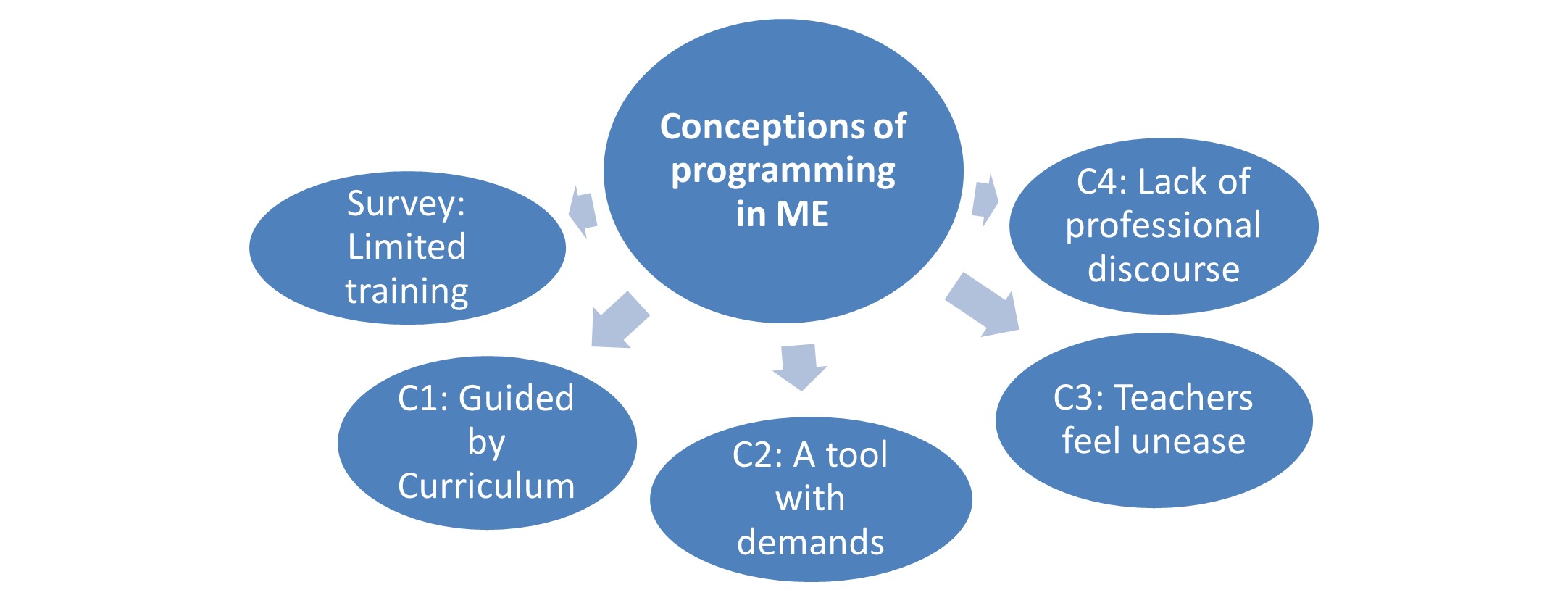
As programming is being integrated into mathematics education in Norway, it is increasingly important to understand how teachers perceive and implement programming. This study investigates Norwegian mathematics teachers’ conceptions, that is their situated understandings and rationales, regarding programming in mathematics education at the primary and lower secondary school levels. Data were collected through semi-structured interviews with four teachers and a nationwide questionnaire answered by 215 teachers, providing both qualitative and quantitative insights. The interviews were analysed using thematic analysis, while the questionnaire provided contextual quantitative insights. The results show that (1) the majority of Norwegian mathematics teachers have no formal education in programming, and many have not received training in programming, yet they are largely positive about introducing programming to their pupils, (2) teachers align their teaching of programming with and are guided by the mathematics curriculum and the exam, (3) teachers view programming as a tool in the subject, however, they are often hindered from realizing programming’s potential by its challenges and limitations, (4) teachers feel unprepared and sometimes uncomfortable teaching programming in mathematics, and (5) there appears to be a lack of appropriate collaborative discourse with consistent terminology on programming in mathematics education among primary and lower secondary school teachers in Norway, which may be contributing to the fragmentation of practice. By shedding light on how teachers conceptualize programming, this study contributes to understanding the pedagogical and structural challenges and opportunities of integrating programming into mathematics education, and highlights areas for future support.
References
Bergqvist, E. (2021). An inquiry of different interpretations of programming in conjunction with mathematics teaching. Norma 20, The ninth Nordic Conference on Mathematics Education, Oslo, Norway, 1–4 June 2021.
Bingolbali, E., & Monaghan, J. (2008). Concept image revisited. Educational studies in Mathematics, 68(1), 19–35. https://doi.org/https://doi.org/10.1007/s10649-007-9112-2 DOI: https://doi.org/10.1007/s10649-007-9112-2
Bocconi, S., Chioccariello, A., Kampylis, P., Dagienė, V., Wastiau, P., Engelhardt, K., Earp, J., Horvath, M. A., Jasutė, E., Malagoli, C., Masiulionytė-Dagienė, V., & Stupurienė, G. (2022). Reviewing computational thinking in compulsory education: State of play and practices from computing education. https://doi.org/10.2760/126955
Braun, V., & Clarke, V. (2006). Using thematic analysis in psychology. Qualitative research in psychology, 3(2), 77–101. https://doi.org/https://doi.org/10.1191/1478088706qp063oa DOI: https://doi.org/10.1191/1478088706qp063oa
Broley, L., Caron, F., & Saint-Aubin, Y. (2018). Levels of programming in mathematical research and university mathematics education. International Journal of Research in Undergraduate Mathematics Education, 4(1), 38–55. https://doi.org/https://doi.org/10.1007/s40753-017-0066-1 DOI: https://doi.org/10.1007/s40753-017-0066-1
Clark, T., Foster, L., Sloan, L., & Bryman, A. (2021). Bryman's social research methods. Oxford University Press.
Denning, P. J., & Tedre, M. (2019). Computational thinking. Mit Press. DOI: https://doi.org/10.7551/mitpress/11740.001.0001
Dilling, F., Köster, J., & Vogler, A. (2024). Beliefs of Undergraduate Mathematics Education Students in a Teacher Education Program about Visual Programming in Mathematics Classes. International Journal of Research in Undergraduate Mathematics Education, 10(3), 700–731. https://doi.org/https://doi.org/10.1007/s40753-024-00248-0 DOI: https://doi.org/10.1007/s40753-024-00248-0
Duncan, C., Bell, T., & Tanimoto, S. (2014). Should your 8-year-old learn coding? Proceedings of the 9th Workshop In Primary and Secondary Computing Education (WIPSCE 2014), DOI: https://doi.org/10.1145/2670757.2670774
Fojcik, M. K. (2022). Perspectives and challenges on programming as a tool to learn mathematics. Proceedings of the Twelfth Congress of the European Society for Research in Mathematics Education (CERME12),
Furinghetti, F., & Pehkonen, E. (2002). Rethinking characterizations of beliefs. In G. C. Leder, E. Pehkonen, & G. Törner (Eds.), Beliefs: A hidden variable in mathematics education? (pp. 39–57). Springer Dordrecht. https://doi.org/https://doi.org/10.1007/0-306-47958-3 DOI: https://doi.org/10.1007/0-306-47958-3_3
Johansson, C., Juhlin, A., Tossavainen, T., & Wedestig, A. (2023). Nyfikenhet och tillräcklighet. Gymnasielärares erfarenheter av att undervisa matematik med programmering. Nämnaren, 49(3), 35–41. https://ncm.gu.se/wp-content/uploads/2024/09/3541_23_3.pdf
Kaufmann, O. T., Maugesten, M., & Meaney, T. J. (2022). Views of pre-service teachers in Norway on the value of programming in teaching mathematical and pedagogical topics. Proceedings of the 13th ERME Topic Conference on Mathematics Education in Digital Age (MEDA3) (ETC13),
Kilhamn, C., Bråting, K., & Rolandsson, L. (2021a). Teachers' arguments for including programming in mathematics education. NORMA 20, The ninth Nordic Conference on Mathematics Education, Oslo, Norway, 1–4 June 2021.
Kilhamn, C., Rolandsson, L., & Bråting, K. (2021b). Programmering i svensk skolmatematik: Programming in Swedish school mathematics. LUMAT: International Journal on Math, Science and Technology Education, 9(1), 283–312. https://doi.org/https://doi.org/10.31129/LUMAT.9.2.1457 DOI: https://doi.org/10.31129/LUMAT.9.2.1457
Meaney, T. J., Huru, H. L., & Kvivesen, M. (2023). Preservice and inservice teachers’ views on digital tools for diverse learners in mathematics education. Nordic Studies in Mathematics Education, 28(3-4), 103–123. https://hdl.handle.net/10037/33305 DOI: https://doi.org/10.7146/nomad.v28i3-4.149192
Ministry of Education and Research. (2019). Curriculum for Mathematics year 1-10 (MAT01-05). Retrieved from https://data.udir.no/kl06/v201906/laereplaner-lk20/MAT01-05.pdf?lang=eng
Misfeldt, M., Jankvist, U. T., Geraniou, E., & Bråting, K. (2020). Relations between mathematics and programming in school: Juxtaposing three different cases. Proceedings of the 10th ERME Topic Conference on Mathematics Education in the Digital Age (MEDA 2020),
Misfeldt, M., Szabo, A., & Helenius, O. (2019). Surveying teachers’ conception of programming as a mathematics topic following the implementation of a new mathematics curriculum. Proceedings of the Eleventh Congress of the European Society for Research in Mathematics Education (CERME11),
Nordby, S. K., Bjerke, A. H., & Mifsud, L. (2022). Primary mathematics teachers’ understanding of computational thinking. KI-Künstliche Intelligenz, 36(1), 35–46. https://doi.org/https://doi.org/10.1007/s40751-022-00102-5 DOI: https://doi.org/10.1007/s13218-021-00750-6
Opre, D. (2015). Teachers’ conceptions of assessment. Procedia-Social and Behavioral Sciences, 209, 229–233. https://doi.org/https://doi.org/10.1016/j.sbspro.2015.11.222 DOI: https://doi.org/10.1016/j.sbspro.2015.11.222
Papert, S. A. (1980). Mindstorms: Children, computers, and powerful ideas. Basic books.
Philipp, R. A. (2007). Mathematics teachers’ beliefs and affect. In F. K. Lester (Ed.), Second handbook of research on mathematics teaching and learning (Vol. 1, pp. 257–315). https://www.researchgate.net/profile/Randolph-Philipp/publication/284039669_Mathematics_teachers%27_beliefs_and_affect/links/674214f5868c966b93271978/Mathematics-teachers-beliefs-and-affect.pdf DOI: https://doi.org/10.1108/978-1-28141-200-320251010
Refvik, K. A. S., & Opsal, H. (2023). Do optional programming courses affect eighth-grade students’ mathematical problem solving? Computers in the Schools, 40(3), 244–261. https://doi.org/https://doi.org/10.1080/07380569.2023.2175634 DOI: https://doi.org/10.1080/07380569.2023.2175634
Rolandsson, L. (2013). Teachers’ Beliefs Regarding Programming Education. In Technology Teachers as Researchers: Philosophical and Empirical Technology Education Studies in the Swedish TUFF Research School (pp. 285–309). Sense Publishers. https://doi.org/https://doi.org/10.1007/978-94-6209-443-7_13 DOI: https://doi.org/10.1007/978-94-6209-443-7_13
Tall, D., & Vinner, S. (1981). Concept image and concept definition in mathematics with particular reference to limits and continuity. Educational studies in Mathematics, 12(2), 151–169. https://doi.org/https://doi.org/10.1007/BF00305619 DOI: https://doi.org/10.1007/BF00305619
Tossavainen, T., Johansson, C., Juhlin, A., & Wedestig, A. (2024). Programming as a mediator of mathematical thinking: Examples from upper secondary students exploring the definite integral. LUMAT – International Journal on Math, Science and Technology Education, 12(3), 78–99. https://www.diva-portal.org/smash/get/diva2:1858392/FULLTEXT01.pdf DOI: https://doi.org/10.31129/LUMAT.12.3.2155
Turgut, M., Kohanová, I., & Gjøvik, Ø. (2024). Developing survey-based measures of mathematics teachers’ pedagogical technology knowledge: a focus on computational thinking and programming tools. Research in Mathematics Education, 1–24. https://doi.org/https://doi.org/10.1080/14794802.2024.2401482 DOI: https://doi.org/10.1080/14794802.2024.2401482
Vergnaud, G. (1998). Towards a cognitive theory of practice. In A. Sierpinska & J. Kilpatrick (Eds.), Mathematics Education as a Research Domain: A Search for Identity: An ICMI Study Book 1 (pp. 227–240). Springer. DOI: https://doi.org/10.1007/978-94-011-5194-8_15
Vergnaud, G. (2009). The theory of conceptual fields. Human development, 52(2), 83–94. https://doi.org/http://dx.doi.org/10.1159%2F000202727 DOI: https://doi.org/10.1159/000202727
Weintrop, D., & Wilensky, U. (2017). Comparing block-based and text-based programming in high school computer science classrooms. ACM Transactions on Computing Education (TOCE), 18(1), 1–25. https://doi.org/https://doi.org/10.1145/3089799 DOI: https://doi.org/10.1145/3089799
Downloads
Published
How to Cite
Issue
Section
Categories
License
Copyright (c) 2025 Martyna Katarzyna Fojcik

This work is licensed under a Creative Commons Attribution 4.0 International License.