
Effects of guiding feedback on students’ performance, calibration, and self-efficacy
Insights from a field study with engineering students
DOI:
https://doi.org/10.31129/LUMAT.14.4.2692Keywords:
mathematics education, technology-based learning, feedback, performance, self-efficacy, calibrationAbstract
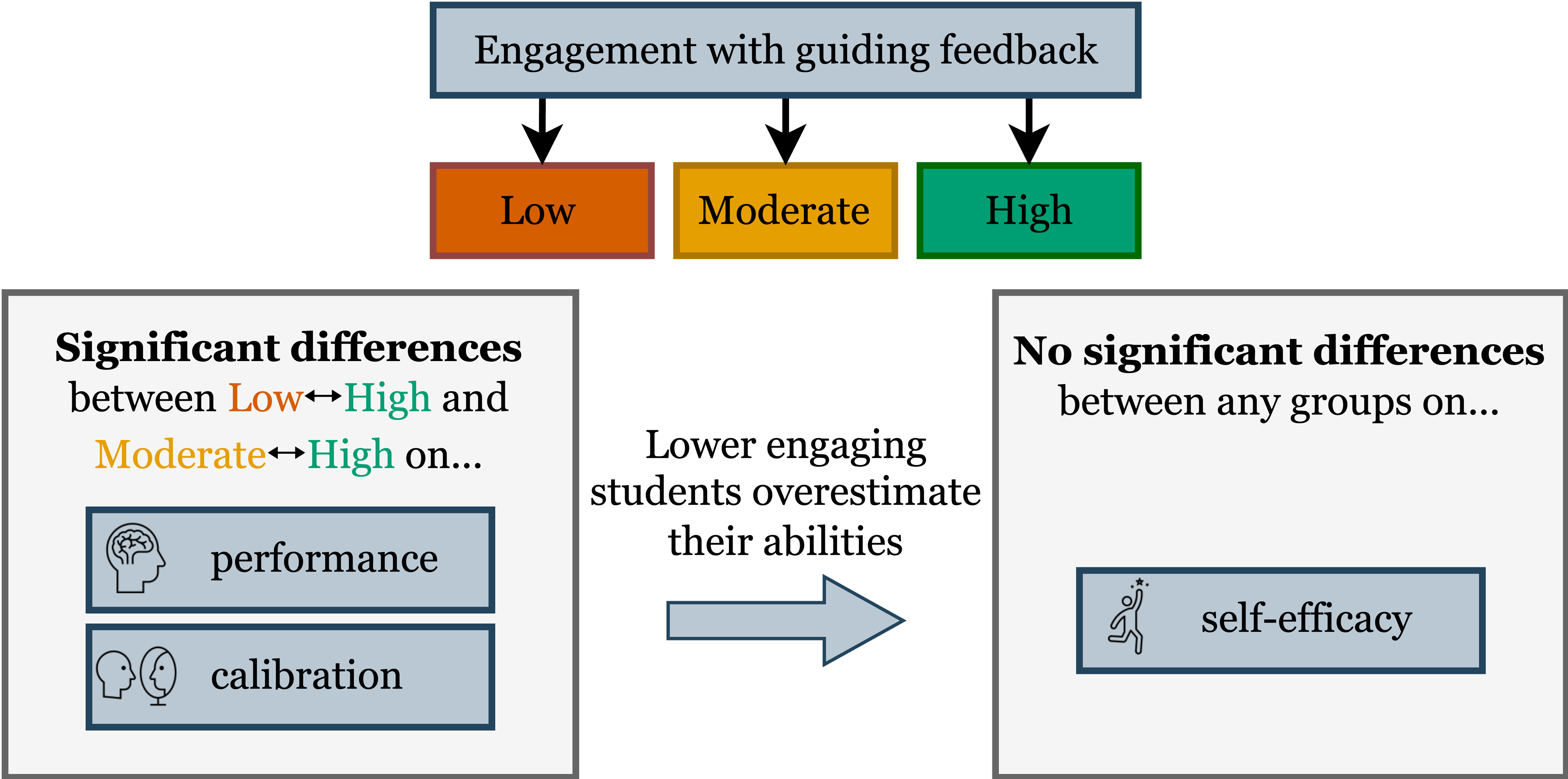
In technology-based learning environments, informative tutoring feedback (ITF) strategies can be implemented to support students during task completion by providing elaborated feedback such as error-specific hints instead of directly showing correct solutions. However, identifying the underlying causes of errors is challenging, especially for more advanced mathematical tasks in higher education. To counteract this issue, an ITF-strategy called guiding feedback has been conceptualized. In the context of guiding feedback, students’ answers are examined based on mathematical properties to identify the causes of their errors and provide error-specific feedback. If students’ error causes cannot be identified, they can work through the task in a series of sub-steps, allowing the system to gain insights into their procedures and facilitating the provision of specific feedback. A previous field study examined the motivational effects of guiding feedback in a mathematics course with engineering students. Contrary to expectations derived from the literature, students who completed more tasks with guiding feedback did not demonstrate significantly higher self-efficacy than those who completed fewer tasks. To investigate whether students who worked on fewer tasks may have inaccurately judged their abilities, the present research extends the previous findings by further analyzing students’ performance and calibration. Based on the number of completed tasks, 196 participants of the field study were grouped into low, moderate, and high engagement categories. We evaluated students’ performance by analyzing their assignments and assessed their calibration by comparing their self-efficacy and performance. Results revealed that students in the high engagement group had significantly better performance and calibration than students in the low and moderate engagement groups. Overall, this research provides a more nuanced understanding of the previous findings by showing that even though guiding feedback may not directly boost students’ self-efficacy, it ensures that their judgments align with their actual performance.
References
Bandura, A. (1997). Self-efficacy: The exercise of control. W. H. Freeman.
Bandura, A. (2006). Guide for constructing self-efficacy scales. In F. Pajares & T. Urdan (Eds.), Self-efficacy beliefs of adolescents (Vol. 5, pp. 307–337). Information Age Publishing.
Bergsten, C., Engelbrecht, J., & Kågesten, O. (2015). Conceptual or procedural mathematics for engineering students: Views of two qualified engineers from two countries. International Journal of Mathematical Education in Science and Technology, 46(7), 979–990. https://doi.org/10.1080/0020739X.2015.1075615
Beyer, S. (2002). The effects of gender, dysphoria, and performance feedback on the accuracy of self-evaluations. Sex Roles, 47, 453–464. https://doi.org/10.1023/A:1021600510857
Boekaerts, M., & Rozendaal, J. S. (2010). Using multiple calibration indices in order to capture the complex picture of what affects students’ accuracy of feeling of confidence. Learning and Instruction, 20(5), 372–382. https://doi.org/10.1016/j.learninstruc.2009.03.002
Bol, L., Hacker, D. J., O’Shea, P., & Allen, D. (2005). The influence of overt practice, achievement level, and explanatory style on calibration accuracy and performance. The Journal of Experimental Education, 73(4), 269–290. https://doi.org/10.3200/JEXE.73.4.269-290
Butler, A. C., Karpicke, J. D., & Roediger, H. L. (2008). Correcting a metacognitive error: Feedback increases retention of low-confidence correct responses. Journal of Experimental Psychology: Learning, Memory, and Cognition, 34(4), 918–928. https://doi.org/10.1037/0278-7393.34.4.918
Butler, D. L., & Winne, P. H. (1995). Feedback and self-regulated learning: A theoretical synthesis. Review of Educational Research, 65(3), 245–281. https://doi.org/10.3102/00346543065003245
Champion, J. K. (2010). The mathematics self-efficacy and calibration of students in a secondary mathematics teacher preparation program. [Doctoral dissertation, University of Northern Colorado].
Chen, P. (2003). Exploring the accuracy and predictability of the self-efficacy beliefs of seventh-grade mathematics students. Learning and Individual Differences, 14(1), 77–90. https://doi.org/10.1016/j.lindif.2003.08.003
Chen, P., & Zimmerman, B. (2007). A cross-national comparison study on the accuracy of self-efficacy beliefs of middle-school mathematics students. The Journal of Experimental Education, 75(3), 221–244. https://doi.org/10.3200/JEXE.75.3.221-244
Cohen, J. (1988). Statistical power analysis for the behavioral sciences (2nd ed.). Lawrence Erlbaum Associates.
Corbalan, G., Paas, F., & Cuypers, H. (2010). Computer-based feedback in linear algebra: Effects on transfer performance and motivation. Computers & Education, 55(2), 692–703. https://doi.org/10.1016/j.compedu.2010.03.002
Das, D. K. (2023). Exploring the impact of feedback on student performance in undergraduate civil engineering. European Journal of Engineering Education, 48(6), 1148–1164. https://doi.org/10.1080/03043797.2023.2238188
Dyrvold, A., & Bergvall, I. (2023). Static, dynamic and interactive elements in digital teaching materials in mathematics: How do they foster interaction, exploration and persistence? LUMAT: International Journal on Math, Science and Technology Education, 11(3), 103–131. https://doi.org/10.31129/LUMAT.11.3.1941
Erens, R., & Eichler, A. (2018). Role of technology in calculus teaching: Beliefs of novice secondary teachers. In B. Rott, G. Törner, J. Peters-Dasdemir, A. Möller, & Safrudiannur (Eds.), Views and beliefs in mathematics education (pp. 221–231). Springer International Publishing. https://doi.org/10.1007/978-3-030-01273-1_20
Erickson, S., & Heit, E. (2015). Metacognition and confidence: Comparing math to other academic subjects. Frontiers in Psychology, 6, 742. https://doi.org/10.3389/fpsyg.2015.00742
Ewers, C. A., & Wood, N. L. (1993). Sex and ability differences in children’s math self-efficacy and prediction accuracy. Learning and Individual Differences, 5(3), 259–267. https://doi.org/10.1016/1041-6080(93)90006-E
García, T., Rodríguez, C., González-Castro, P., González-Pienda, J. A., & Torrance, M. (2016). Elementary students’ metacognitive processes and post-performance calibration on mathematical problem-solving tasks. Metacognition and Learning, 11(2), 139–170. https://doi.org/10.1007/s11409-015-9139-1
Gjicali, K., & Lipnevich, A. A. (2021). Got math attitude? (In)direct effects of student mathematics attitudes on intentions, behavioral engagement, and mathematics performance in the U.S. PISA. Contemporary Educational Psychology, 67, 102019. https://doi.org/10.1016/j.cedpsych.2021.102019
Gravill, J. I., Compeau, D. R., & Marcolin, B. L. (2006). Experience effects on the accuracy of self-assessed user competence. Information & Management, 43(3), 378–394. https://doi.org/10.1016/j.im.2005.10.001
Hacker, D. J., Bol, L., Horgan, D. D., & Rakow, E. A. (2000). Test prediction and performance in a classroom context. Journal of Educational Psychology, 92(1), 160–170. https://doi.org/10.1037/0022-0663.92.1.160
Härterich, J. (2019). Using randomized quizzes in undergraduate linear algebra and multivariable calculus. In Contributions to the 1st International STACK conference 2018. Friedrich-Alexander-Universität Erlangen-Nürnberg. https://doi.org/10.5281/zenodo.2582873
Honicke, T., & Broadbent, J. (2016). The influence of academic self-efficacy on academic performance: A systematic review. Educational Research Review, 17, 63–84. https://doi.org/10.1016/j.edurev.2015.11.002
Jonsson, A. (2013). Facilitating productive use of feedback in higher education. Active Learning in Higher Education, 14(1), 63–76. https://doi.org/10.1177/1469787412467125
Kaarakka, T., Helkala, K., Valmari, A., & Joutsenlahti, M. (2019). Pedagogical experiments with MathCheck in university teaching. Lumat: International Journal of Math, Science and Technology Education, 7(3), 84–112. https://doi.org/10.31129/LUMAT.7.3.428
Khazanchi, R., Di Mitri, D., & Drachsler, H. (2025). The effect of AI-based systems on mathematics achievement in rural context: A quantitative study. Journal of Computer Assisted Learning, 41(1), e13098. https://doi.org/10.1111/jcal.13098
Kojo, A., Laine, A., & Näveri, L. (2018). How did you solve it? – Teachers’ approaches to guiding mathematics problem solving. Lumat: International Journal of Math, Science and Technology Education, 6(1), 22–40. https://doi.org/10.31129/LUMAT.6.1.294
Kruger, J., & Dunning, D. (1999). Unskilled and unaware of it: How difficulties in recognizing one’s own incompetence lead to inflated self-assessments. Journal of Personality and Social Psychology, 77(6), 1121–1134. https://doi.org/10.1037/0022-3514.77.6.1121
Kuklick, L., Greiff, S., & Lindner, M. A. (2023). Computer-based performance feedback: Effects of error message complexity on cognitive, metacognitive, and motivational outcomes. Computers & Education, 200, 104785. https://doi.org/10.1016/j.compedu.2023.104785
Kunwar, R. (2021). A study on low-performing students’ perception towards mathematics: A case of secondary-level community school students of Nepal. Researcher: A Research Journal of Culture and Society, 5(1), 125–137. https://doi.org/10.3126/researcher.v5i1.41384
Labuhn, A. S., Zimmerman, B. J., & Hasselhorn, M. (2010). Enhancing students’ self-regulation and mathematics performance: The influence of feedback and self-evaluative standards. Metacognition and Learning, 5, 173–194. https://doi.org/10.1007/s11409-010-9056-2
Lache, J., Rolka, K., Kallweit, M., Dehling, H., & Meißner, D. (2021). Open educational resources for engineering statistics. In H.-U. Heiß, H.-M. Järvinen, A. Mayer, & A. Schulz (Eds.), Blended learning in engineering education: Challenging, enlightening – and lasting? (pp. 995–1004). SEIFI.
McIntosh, R. D., Moore, A. B., Liu, Y., & Della Sala, S. (2022). Skill and self-knowledge: Empirical refutation of the dual-burden account of the Dunning–Kruger effect. Royal Society Open Science, 9(12), 191727. https://doi.org/10.1098/rsos.191727
Morris, R., Perry, T., & Wardle, L. (2021). Formative assessment and feedback for learning in higher education: A systematic review. Review of Education, 9(3), e3292. https://doi.org/10.1002/rev3.3292
Narciss, S. (2008). Feedback strategies for interactive learning tasks. In J. M. Spector, M. D. Merrill, J. J. G. van Merrienboer, & M. P. Driscoll (Eds.), Handbook of research on educational communications and technology (3rd ed., pp. 125–144). Lawrence Erlbaum.
Narciss, S. (2012). Feedback strategies. In N. M. Seel (Ed.), Encyclopedia of the sciences of learning (pp. 1289–1293). Springer. https://doi.org/10.1007/978-1-4419-1428-6_283
Narciss, S., & Huth, K. (2004). How to design informative tutoring feedback for multi-media learning. In H. M. Niegemann, D. Leutner, & R. Brünken (Eds.), Instructional design for multimedia learning (pp. 181–195). Waxmann.
Narciss, S., & Huth, K. (2006). Fostering achievement and motivation with bug-related tutoring feedback in a computer-based training for written subtraction. Learning and Instruction, 16(4), 310–322. https://doi.org/10.1016/j.learninstruc.2006.07.003
Narciss, S., Sosnovsky, S., Schnaubert, L., Andrès, E., Eichelmann, A., Goguadze, G., & Melis, E. (2014). Exploring feedback and student characteristics relevant for personalizing feedback strategies. Computers & Education, 71, 56–76. https://doi.org/10.1016/j.compedu.2013.09.011
Narciss, S., & Zumbach, J. (2023). Formative assessment and feedback strategies. In J. Zumbach, D. A. Bernstein, S. Narciss, & G. Marsico (Eds.), International handbook of psychology learning and teaching (pp. 1359–1386). Springer International Publishing. https://doi.org/10.1007/978-3-030-28745-0_63
Nietfeld, J. L., Cao, L., & Osborne, J. W. (2005). Metacognitive monitoring accuracy and student performance in the postsecondary classroom. The Journal of Experimental Education, 74(1), 7–28.
Nietfeld, J. L., & Schraw, G. (2002). The effect of knowledge and strategy training on monitoring accuracy. The Journal of Educational Research, 95(3), 131–142. https://doi.org/10.1080/00220670209596583
Opesemowo, O. A. G., & Adewuyi, H. O. (2024). A systematic review of artificial intelligence in mathematics education: The emergence of 4IR. Eurasia Journal of Mathematics, Science and Technology Education, 20(7), em2478. https://doi.org/10.29333/ejmste/14762
Osterhage, J. L., Usher, E. L., Douin, T. A., & Bailey, W. M. (2019). Opportunities for self-evaluation increase student calibration in an introductory biology course. CBE—Life Sciences Education, 18(2), 16. https://doi.org/10.1187/cbe.18-10-0202
Paas, F., Renkl, A., & Sweller, J. (2003). Cognitive load theory and instructional design: Recent developments. Educational Psychologist, 38(1), 1–4. https://doi.org/10.1207/S15326985EP3801_1
Pajares, F., & Graham, L. (1999). Self-efficacy, motivation constructs, and mathematics performance of entering middle school students. Contemporary Educational Psychology, 24(2), 124–139. https://doi.org/10.1006/ceps.1998.0991
Pajares, F., & Miller, M. D. (1994). Role of self-efficacy and self-concept beliefs in mathematical problem solving: A path analysis. Journal of Educational Psychology, 86(2), 193–203. https://doi.org/10.1037/0022-0663.86.2.193
Pals, F. F. B., Tolboom, J. L. J., & Suhre, C. J. M. (2023). Development of a formative assessment instrument to determine students’ need for corrective actions in physics: Identifying students’ functional level of understanding. Thinking Skills and Creativity, 50, 101387. https://doi.org/10.1016/j.tsc.2023.101387
Park, L. E., Ward, D. E., Moore-Russo, D., Rickard, B., Vessels, V., & Hundley, J. (2026). Positive feedback as a lever to boost students’ STEM outcomes. Personality and Social Psychology Bulletin, 52(1), 176–197. https://doi.org/10.1177/01461672241265954
Razeghpour, F. (2024a). Conception of two informative tutoring feedback strategies for mathematical tasks with STACK. In P. Iannone, F. Moons, C. Drüke-Noe, E. Geraniou, F. Morselli, K. Klingbeil, M. Veldhuis, & S. Olsher (Eds.), Proceedings of FAME 1 – Feedback & Assessment in Mathematics Education (pp. 254–261). Utrecht University & ERME. https://doi.org/10.5281/zenodo.14231455
Razeghpour, F. (2024b). Exploring the influence of guiding feedback on mathematical self-efficacy: Insights from a field study with engineering students. LUMAT-B: International Journal on Math, Science and Technology Education, 9(2). https://urn.fi/urn:nbn:fi:hulib:editori:lumatb.v9i21
Razeghpour, F., & Rolka, K. (2026). Informative tutoring feedback strategies in higher education: Effects on students’ performance, self-efficacy, and calibration [Unpublished manuscript].
Saks, K. (2024). The effect of self-efficacy and self-set grade goals on academic outcomes. Frontiers in Psychology, 15, 1324007. https://doi.org/10.3389/fpsyg.2024.1324007
Sangwin, C., & Köcher, N. (2016). Automation of mathematics examinations. Computers & Education, 94, 215–227. https://doi.org/10.1016/j.compedu.2015.11.014
Schlösser, T., Dunning, D., Johnson, K. L., & Kruger, J. (2013). How unaware are the unskilled? Empirical tests of the “signal extraction” counterexplanation for the Dunning–Kruger effect in self-evaluation of performance. Journal of Economic Psychology, 39, 85–100. https://doi.org/10.1016/j.joep.2013.07.004
Sheldrake, R., Mujtaba, T., & Reiss, M. J. (2022). Implications of under-confidence and over-confidence in mathematics at secondary school. International Journal of Educational Research, 116, 102085. https://doi.org/10.1016/j.ijer.2022.102085
Skaalvik, E. M., Federici, R. A., & Klassen, R. M. (2015). Mathematics achievement and self-efficacy: Relations with motivation for mathematics. International Journal of Educational Research, 72, 129–136. https://doi.org/10.1016/j.ijer.2015.06.008
Stajkovic, A. D., & Sommer, S. M. (2000). Self-efficacy and causal attributions: Direct and reciprocal links. Journal of Applied Social Psychology, 30(4), 707–737. https://doi.org/10.1111/j.1559-1816.2000.tb02820.x
Sunzuma, G. (2023). Technology integration in geometry teaching and learning: A systematic review (2010–2022). LUMAT: International Journal on Math, Science and Technology Education, 11(3), 1–18. https://doi.org/10.31129/LUMAT.11.3.1938
Sweller, J. (2011). Cognitive load theory. In Jose P. Mestre & Brian H. Ross (Eds.), Psychology of learning and motivation (Vol. 55, pp. 37–76). Academic Press. https://doi.org/10.1016/B978-0-12-387691-1.00002-8
Taraban, R., Anderson, E. E., DeFinis, A., Brown, A. G., Weigold, A., & Sharma, M. P. (2007). First steps in understanding engineering students’ growth of conceptual and procedural knowledge in an interactive learning context. Journal of Engineering Education, 96(1), 57–68. https://doi.org/10.1002/j.2168-9830.2007.tb00915.x
Timms, M., DeVelle, S., & Lay, D. (2016). Towards a model of how learners process feedback: A deeper look at learning. Australian Journal of Education, 60(2), 128–145. https://doi.org/10.1177/0004944116652912
Usher, E. L., & Pajares, F. (2006). Sources of academic and self-regulatory efficacy beliefs of entering middle school students. Contemporary Educational Psychology, 31(2), 125–141. https://doi.org/10.1016/j.cedpsych.2005.03.002
Viholainen, A., Tossavainen, T., Viitala, H., & Johansson, M. (2019). University mathematics students’ self-efficacy beliefs about proof and proving. Lumat: International Journal of Math, Science and Technology Education, 7(1), 148–164. https://doi.org/10.31129/LUMAT.7.1.406
Winstone, N. E., Nash, R. A., Parker, M., & Rowntree, J. (2017). Supporting learners’ agentic engagement with feedback: A systematic review and a taxonomy of recipience processes. Educational Psychologist, 52(1), 17–37. https://doi.org/10.1080/00461520.2016.1207538
Yang Hansen, K., Thorsen, C., Radišić, J., Peixoto, F., Laine, A., & Liu, X. (2024). When competence and confidence are at odds: A cross-country examination of the Dunning–Kruger effect. European Journal of Psychology of Education, 39(2), 1537–1559. https://doi.org/10.1007/s10212-024-00804-x
Zientek, L. R., Fong, C. J., & Phelps, J. M. (2017). Sources of self-efficacy of community college students enrolled in developmental mathematics. Journal of Further and Higher Education, 43(2), 183–200. https://doi.org/10.1080/0309877X.2017.1357071
Downloads
Published
How to Cite
Issue
Section
Categories
License
Copyright (c) 2026 Farhad Razeghpour, Katrin Rolka

This work is licensed under a Creative Commons Attribution 4.0 International License.