
Teknikundervisning och särskild begåvning
Hur möter teknikämnets läromedel för högstadiet elevers behov av komplexitet?
DOI:
https://doi.org/10.31129/LUMAT.14.2.3137Keywords:
särskild begåvning, teknikundervisning, komplexitet, läromedel, aktiviteterAbstract
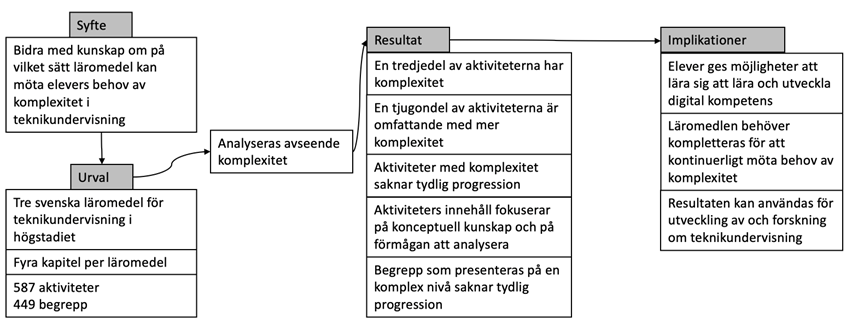
Denna artikel syftar till att bidra med kunskap om på vilket sätt läromedel i teknik kan möta elevers behov av komplexitet i teknikundervisningen. Fokus ligger på elever som exempelvis har särskild begåvning och därför har ett uttalat behov av mer komplexa utmaningar. I studien ingår de tre tryckta läromedel för teknikämnets högstadium som fanns vid tillfället för studien med fyra kapitel vardera. Aktiviteter har undersökts med ramverket AKTA som analytiskt verktyg, och centrala begrepp i elevtexter har analyserats med en kodningsmanual i tre nivåer. Aktiviteter utgörs av alla de presenterade uppgifter och övningar som elever kan utföra för att lära ett innehåll och där vissa aktiviteter anses som komplexa. Resultaten visar att komplexa aktiviteter till största delen fokuserar på konceptuella kunskaper och på att analysera teknik och tekniska lösningar. Komplexitet förekommer i en tredjedel av alla undersökta aktiviteter, och det saknas en tydlig progression. I elevtexterna är en tredjedel av de undersökta centrala tekniska begreppen presenterade på en komplex nivå. Från resultaten diskuteras att aktiviteterna är begränsade i omfattning och en implikation är att elever erbjuds att lära sig att lära och att utveckla viss digital kompetens. Vidare dras slutsatsen att teknikläromedel kan behöva kompletteras genom olika didaktiska beslut för att kontinuerligt möta elevers behov av komplexitet. Denna studie bidrar både till teknikdidaktisk forskning och till forskning om elever med särskild begåvning genom att belysa på vilket sätt läromedel i teknikämnet möter behov av komplexitet. Studien bidrar dessutom till lärarprofessionen genom att synliggöra vikten av olika didaktiska val vid planering, genomförande, utvärdering, och utveckling av teknikundervisning.
Technology education and giftedness: How do textbooks in lower secondary technology education meet students’ need for complexity?
This article examines how technology education textbooks can address students’ need for complexity, with a focus on gifted students. The study investigates three printed lower secondary technology textbooks available at the time, each with four chapters. Activities within the textbooks were analyzed using the AKTA framework, while key concepts from text books were analyzed with a three-level coding scheme. Activities entail all tasks and exercises through which students learn subject content, some of which are considered complex activities. The results reveal that approximately one third of the activities contain elements of complexity, and there is no clear progression of complexity. Most activities aim to develop students’ conceptual knowledge and their ability to analyze technology. One third of the key concepts are presented at a complex level. Based on the results, it is argued that the activities are limited in scope. Even so, students are offered opportunities to learn how to learn and to develop certain aspects of digital competence through information-seeking processes. Furthermore, it is concluded that teachers play a pivotal role in designing technology education that incorporates activities with elements of complexity. Teaching based solely on textbooks does not appear to be sufficient to continuously meet the need for complexity among gifted students. This study contributes to technology education research and research on gifted students by examining how technology education textbooks address the need for complexity. It also contributes to the teaching profession by highlighting the importance of pedagogical choices in planning, implementation, evaluation, and development of technology education.
Keywords: giftedness, technology education, complexity, educational textbooks, activities
References
Ammert, N. (2011). Ett innehåll förmedlas. I N. Ammert (Red.), Att spegla världen. Läromedelsstudier i teori och praktik (ss. 10–100). Studentlitteratur.
Anderson, L. W., & Krathwohl, D. R. (2001). A taxonomy for learning, teaching and assessing: A revision of Bloom's Taxonomy of educational objectives: Complete edition. Longman.
Barak, M. (2013). Teaching engineering and technology: Cognitive, knowledge and problem-solving taxonomies. Journal of Engineering, Design and Technology, 11(3), 316–333. https://doi.org/10.1108/JEDT-04-2012-0020
Bjurulf, V., & Kilbrink, N. (2008). The importance of interweaving theoretical and practical tasks in technology education. Exploring Technology Education: Solutions to Issues in a Globalised World: Proceedings of the 5th Biennial International Conference on Technology Education: Volume One (TERC 2008), Surfers Paradise, QLD. https://search.informit.org/doi/10.3316/informit.753232195083391
Borland, J. H. (2005). Gifted Education Without Gifted Children: The Case for No Conception of Giftedness. I R. J. Sternberg & J. E. Davidson (Red.), Conceptions of Giftedness (ss. 1–19). Cambridge University Press.
Borland, J. H. (2021). The trouble with conceptions of giftedness. I R. J. Sternberg & D. Ambrose (Red.), Conceptions of Giftedness and Talent (ss. 37–50). Palgrave Macmillan.
Brink, H. (2025a). The complexity, autonomy, authenticity, and support (CAAS) framework for gifted students’ needs in technology education: A systematic literature review. Roeper Review, 1–11. https://doi.org/10.1080/02783193.2025.2466514
Brink, H. (2025b). Ramverk för analys av komplexitet i teknikundervisningens aktiviteter: AKTA. Nordic Studies in Science Education, 21(2), 222–235. https://doi.org/10.5617/nordina.12225
Citrohn, B., & Lovén, K. (2022). Stella teknik 7–9. Natur & Kultur.
Dai, D. Y., & Chen, F. (2013). Three paradigms of gifted education: In search of conceptual clarity in research and practice. The Gifted Child Quarterly, 57, 151–168. https://doi.org/10.1177/0016986213490020
de Vries, M. J. (2016). Teaching about technology: An introduction to the philosophy of technology for non-philosophers. Springer.
European Commission. (2019). Key competences for lifelong learning. Publications office. https://data.europa.eu/doi/10.2766/569540
Fahrman, B., Norström, P., & Gumaelius, L. (2018, 18 jun – 21 jun). Changing competencies, changing attitudes? How teachers become technology teachers. PATT36, Pupils' Attitudes Towards Technology Conference, Westmeath, Ireland. https://www.skolfi.se/wp-content/uploads/2018/04/PATT36-Proceedings.pdf
Freeman, J. (2004). Teaching the gifted and talented. Education Today, 54, 17–21.
Frid, H., & Henderson, F. (2023). Titano teknik. Gleerups.
Gagné, F. (2021). Differentiating giftedness from talent: The DMGT perspective on talent development. Routledge.
Gilbert, J. K. (1992). The interface between science education and technology education. International Journal of Science Education, 14(5), 563–578. https://doi.org/10.1080/0950069920140507
Hallström, J., & Stolpe, K. (2024). Teknisk multilitteracitet – att fånga det komplexa kunnande i teknikämnet. I A. Larsson, C. Nordlöf, J. Bernhard, & J. Hallström (Red.), Från teori till teknikundervisning. NATDID Nationellt centrum för naturvetenskapernas och teknikens didaktik. https://www.diva-portal.org/smash/get/diva2:1936372/FULLTEXT01.pdf
Häger, J., Lindström, P., & Warell, J. (2023). Teknik 7–9. Nationalencyklopedin AB.
Ingenjören. (2021). Så förändras efterfrågan på civilingenjörer till 2035. https://www.ingenjoren.se/2021/04/27/sa-forandras-efterfragan-pa-civilingenjorer-till-2035/
IVA. (2024). Det är ju inte allmänbildning direkt: 10–15-åringars syn på naturvetenskap och teknik. Kungliga Ingenjörsvetenskapsakademien. https://www.iva.se/contentassets/ee2bcb7c467848bf82bc2381bdb226d9/iva-framtidenskunskapssamhalle-rapport.pdf
Lipman, M. (2003). Thinking in education. Cambridge University Press.
Lo, M. L. (2012). Variation theory and the improvement of teaching and learning. Acta universitatis Gothoburgensis.
Marton, F. (2015). Necessary conditions of learning. Routledge.
Marton, F., & Tsui, A. (2004). Classroom discourse and the space of learning. Lawrence Erlbaum.
Mellroth, E. (2018). Harnessing teachers’ perspectives – Recognizing mathematically highly able pupils and orchestrating teaching for them in a diverse ability classroom [Doktorsavhandling, Karlstads universitet]. DiVA. https://kau.diva-portal.org/smash/get/diva2:1253540/FULLTEXT02.pdf
OECD. (2021). Policy approaches and initiatives for the inclusion of gifted students in OECD countries. OECD education working paper, 262. https://doi.org/10.1787/c3f9ed87-en
Plants, H. L., Dean, R. K., Sears, J. T., & Venable, W. S. (1980). A taxonomy of problem-solving activities and its implications for teaching. I J. L. Lubkin (Red.), The teaching of elementary problem solving in engineering and related fields (ss. 21–34). American society for engineering education. https://files.eric.ed.gov/fulltext/ED243714.pdf
Regeringskansliet. (2025). En STEM-strategi för Sverige. https://www.regeringen.se/contentassets/074ae44c1f0846ceb845c9aa62848114/en-stem-strategi-for-sverige.pdf
Reis, S. M., Renzulli, S. J., & Renzulli, J. S. (2021). Enrichment and gifted education pedagogy to develop talents, gifts, and creative productivity. Education Sciences, 11(10), 615. https://doi.org/10.3390/educsci11100615
Renzulli, J. S., & Reis, S. M. (2014). Schoolwide enrichment model (3 uppl.). Routledge. https://doi.org/10.4324/9781003238904
Rogers, K. B. (2007). Lessons learned about educating the gifted and talented: A synthesis of the research on educational practice. Gifted child quarterly, 51(4), 382–396. https://doi.org/10.1177/0016986207306324
SFS 2010:800. Skollag. https://www.riksdagen.se/sv/dokument-lagar/dokument/svensk-forfattningssamling/skollag-2010800_sfs-2010-800
Sims, C. (2023). From 'the genius' to 'the gifted’: The conceptualisations of giftedness in educational discourse in Sweden [Doktorsavhandling, Uppsala universitet]. DiVA. https://uu.diva-portal.org/smash/get/diva2:1803532/FULLTEXT01.pdf
Skolinspektionen. (2014). Teknik – gör det osynliga synligt: Om kvaliteten i grundskolans teknikundervisning. https://skolinspektionen.se/globalassets/02-beslut-rapporter-stat/granskningsrapporter/tkg/2014/teknik/kvalgr-teknik-slutrapport.pdf
Skolinspektionen. (2019). Digitala verktyg i undervisningen: Matematik och teknik i årskurs 7–9. https://www.skolinspektionen.se/globalassets/02-beslut-rapporter-stat/granskningsrapporter/tkg/2019/digitala-verktyg/digitala-verktyg-i-undervisningen.pdf
Skolverket. (2022a). Kursplan teknik. https://www.skolverket.se/undervisning/grundskolan/laroplan-och-kursplaner-for-grundskolan/laroplan-lgr22-for-grundskolan-samt-for-forskoleklassen-och-fritidshemmet?url=-996270488%2Fcompulsorycw%2Fjsp%2Fsubject.htm%3FsubjectCode%3DGRGRTEK01%26tos%3Dgr&sv.url=12.5dfee44715d35a5cdfa219f
Skolverket. (2022b). Läroplan för grundskolan samt för förskoleklassen och fritidshemmet: Lgr22. https://www.skolverket.se/undervisning/grundskolan/laroplan-och-kursplaner-for-grundskolan/laroplan-lgr22-for-grundskolan-samt-for-forskoleklassen-och-fritidshemmet
Sultan, U. (2024). In whose eyes am I technical? Exploring the ‘problem’ of the (non)technical girl [Doktorsavhandling, Linköpings universitet].
Sundqvist, P., Engström, S., & Nordlöf, C. (2025). The teacher's guide's way of communicating with the teacher–within the subject of technology. Design and Technology Education: An International Journal, 30(1), 45–62. https://doi.org/10.24377/DTEIJ.article3042
Svensson, M., Högfeldt Rudervall, M., Nylén, B., Nylén, B., Olsson, B., Börjesson, G., Chocron, M., & Sjöström, I.-L. (2018). Teknik direkt. Sanoma utbildning.
Tirri, K., & Laine, S. (2017). Ethical challenges in inclusive education: The case of gifted students, ethics, equity, and inclusive education. International Perspectives on Inclusive Education, 9, 239–257. https://doi.org/10.1108/S1479-363620170000009010
Tomlinson, C. A. (2016). The differentiated classroom: Responding to the needs of all learners. Pearson education.
UNESCO. (1994). The Salamanca statement and framework for action on special needs education world conference on special needs education. https://unesdoc.unesco.org/ark:/48223/pf0000098427/PDF/098427engo.pdf.multi
Unicef. (2017). Inclusive Education. Understanding Article 24 of the Convention on the Rights of Persons with Disabilities. https://www.unicef.org/eca/sites/unicef.org.eca/files/IE_summary_accessible_220917_0.pdf
United Nations. (1989). Convention on the rights of the child. http://www.ohchr.org/Documents/ProfessionalInterest/crc.pdf
Varg, L. (2024). Fröken är lik sin fröken: Om vad som påverkar lärares didaktiska vägval och formar NO-undervisning på mellanstadiet [Doktorsavhandling, Umeå universitet]. DiVA. https://www.diva-portal.org/smash/get/diva2:1854130/FULLTEXT02.pdf
Westman, A.-K., Jidesjö, A., & Oskarsson, M. (2025). Reoccurring science identities: Swedish secondary students’ interest in science and technology examined 2003 and 2020. Nordic Studies in Science Education, 25(1), 102–116. https://doi.org/10.5617/nordina.10260
Ziernwald, L., Hillmayr, D., & Holzberger, D. (2022). Promoting high-achieving students through differentiated instruction in mixed-ability classrooms – A systematic review. Journal of Advanced Academics, 33(4), 540–573. https://doi.org/10.1177/1932202X221112931
Downloads
Published
How to Cite
License
Copyright (c) 2026 Helen Brink

This work is licensed under a Creative Commons Attribution 4.0 International License.