
Exploring learning in a self-paced online mathematics course for NEET learners
Insights into learning outcomes and self-direction
DOI:
https://doi.org/10.31129/LUMAT.14.2.3152Keywords:
Mathematics, Self-direction, Empathy, NEETAbstract
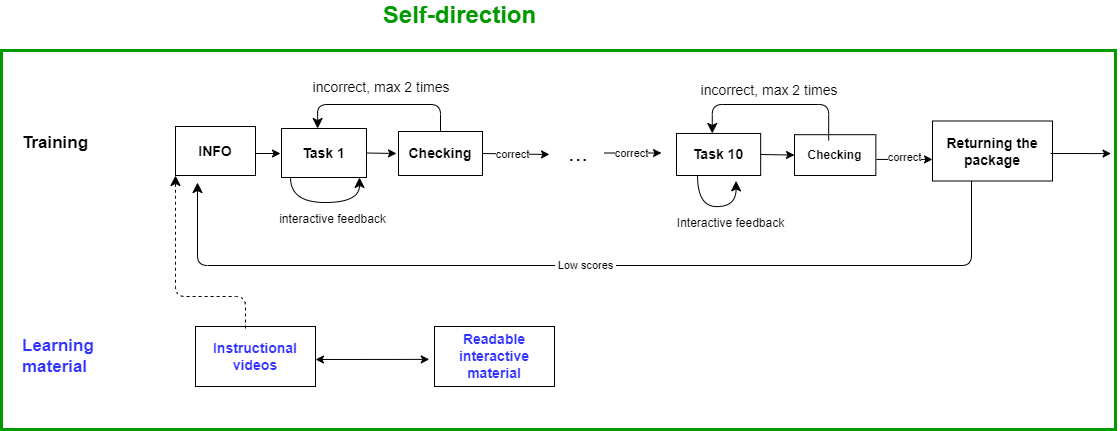
This article examines the design and evaluation of a self-paced online mathematics course developed for NEET (Not in Education, Employment, or Training) learners in Finland. The course aims to lower barriers to education by providing foundational mathematics, digital skills, and field-specific modules, all structured to support self-directed learning (SDL). The pedagogical model emphasizes authenticity, guidance, and feedback-rich assessment to foster learner autonomy and engagement. The study analyses quantitative data from three pilot groups (2024–2025), revealing statistically significant improvements in mathematical skills among participants. Key SDL dimensions - motivation to learn and self-control - were found to be associated with course completion, though high scores in Self-Directed Learning Readiness Scale (SDLRS) alone did not guarantee success, highlighting the importance of additional factors such as time management and accurate self-assessment. Participant feedback was generally positive, though technical barriers, particularly a complex login process, affected participation rates. The findings underscore the importance of accessible onboarding, immediate feedback, and inclusive learning environments. The results demonstrate that a well-designed, flexible, and feedback-rich online course can effectively support the development of mathematical skills and self-directed learning among NEET learners, thereby promoting their re-engagement with education.
References
Aldrup, K., Carstensen, B., & Klusmann, U. (2022). Is Empathy the Key to Effective Teaching? A Systematic Review of Its Association with Teacher-Student Interactions and Student Outcomes. Educational Psychology Review, 34, 1–40. https://doi.org/10.1007/s10648-021-09649-y
Amour, I. (2023). STACK for interactive online numerical analysis tutorials: Development, competence and performance. Journal of ICT Systems, 1(1), 1–18. https://doi.org/10.56279/jicts.v1i1.17
Artino, A. (2008). Promoting Academic Motivation and Self-Regulation: Practical Guidelines for Online Instructors. TechTrends, 52(3), 37–45.
Bloom, B. (1968). Learning for mastery. Evaluation Comment, 1(2). https://files.eric.ed.gov/fulltext/ED053419.pdf
Bloom, B. (1984). The 2 Sigma Problem: The search for Methods of Group Instruction as Effective as One-to-One Tutoring. Educational Researcher, 13(6), 4–16.
Brown, K. (2023). eAssessment in engineering mathematics: Gaps in perceptions of students and academics [University of Glasgow]. https://theses.gla.ac.uk/
Brubacher, M. R., & Silinda, F. T. (2021). First-Generation Students in Distance Education Program: Family Resources and Academic Outcomes. The International Review of Research in Open and Distributed Learning, 22(1), 135–147. https://doi.org/10.19173/irrodl.v22i1.4872
Culduz, M. (2024). Benefits and Challenges of E-Learning, Online Education, and Distance Learning. In Incorporating the Human Element in Online Teaching and Learning (pp. 1–27). https://www.researchgate.net/publication/379274516_Benefits_and_Challenges_of_E-Learning_Online_Education_and_Distance_Learning
de Brujin, E., & Leeman, Y. (2010). Authentic and self-directed learning in vocational education: Challenges to vocational educators. Teaching and Teacher Education, 27, 694–702.
Elibol, S., & Bozkurt, A. (2023). Student Dropout as a Never-Ending Evergreen Phenomenon of Online Distance Education. European Journal of Investigation in Health, Psychology and Education. https://doi.org/10.3390/ejihpe13050069
Engelbrecht, J., Llinares, S., & Borba, M. (2020). Transformation of the mathematics classroom with the internet. ZDM Mathematics Education, 5.
Faza, A., & Lestari, I. A. (2025). Self-Regulated Learning in the Digital Age: A Systematic Review of Strategies, Technologies, Benefits, and Challenges. International Review of Research in Open and Distributed Learning, 26(2).
Fisher, M. J., & King, J. (2010). The self-directed learning readiness scale for nursing education revisited: A confirmatory factor analysis. Nurse Education Today, 30(1), 44–48. https://doi.org/10.1016/j.nedt.2009.05.020
Garrison, D. (1997). Self-Directed Learning: Towards a comprehensive model. Adult Education Quarterly, 48(1).
Hattie, J., & Timperley, H. (2007). The Power of Feedback. Review of Educational Research, 77(1), 81–112. https://doi.org/10.3102/003465430298487
Hurme, J., Porras, P., & Lähteenmäki, H. (2023). Enhancing Mathematical Skills for Vocational School Students Pursuing Undergraduate Studies. 557–569. https://doi.org/10.22492/issn.2435-9467.2023.43
Hurme, J., Porras, P., & Lähteenmäki, H. (2026). WIP: Improving Assessment and Feedback with Interactive Exercises. Frontiers in Education. https://doi.org/10.1109/FIE63693.2025.11328510
Huttunen, O. (2022, April 5). Näissä ammateissa on nyt pahin pula tekijöistä – katso lista (There is now the greatest shortage of workers in these professions – see the list.). Ilta-Sanomat. https://www.is.fi/taloussanomat/art-2000008729567.html
Ihantola, P., Fronza, I., Mikkonen, T., Noponen, M., & Hellas, A. (2020). Deadlines and MOOCs: How Do Students Behave in MOOCs with and without Deadlines. 2020 IEEE Frontiers in Education Conference (FIE), 1–9. https://doi.org/10.1109/FIE44824.2020.9274023
Jin, F., Dai, W., Maheshi, B., Martinez-Maldonado, R., Gašević, R., & Tsai, Y.-S. (2025). Feedback in K-12 and higher education: Educators’ perspectives. Teaching and Teacher Education, 156.
JSXGraph Team. (2024). JSXGraph Documentation. https://jsxgraph.org/docs/index.html
Knof, H., Berndt, M., & Shiozawa, T. (2024). Prevalence of Dunning-Kruger effect in first semester medical students: A correlational study of self-assessment and actual academic performance. BMC Medical Education, 24(1), 1210. https://doi.org/10.1186/s12909-024-06121-7
Kõiv, K., Saks, K., Gencel, I. E., Güven, K. M., Azzopardi, A., Todoroska, V., & Petkovska, E. (2024). An intervention model for developing self-directed learning skills in NEET-youth: A literature review. Frontiers in Education, 9. https://doi.org/10.3389/feduc.2024.1433484
Lähteenmäki, H., Hurme, J., & Porras, P. (2024). Design of Interactive STACK Exercises Using JSXGraph for Online Course: Exploring Strategies for Supporting Students with Mathematical Challenges. Proceedings of the 16th International Conference on Computer Supported Education, 2, 549–556.
Liang, K., Wang, C., Zhang, Y., & Zou, W. (2018). Knowledge Aggregation and Intelligent Guidance for Fragmented Learning. Procedia Computer Science, 131, 656–664. https://doi.org/10.1016/j.procs.2018.04.309
Malecka, B., Boud, D., & Carless, D. (2022). Eliciting, processing and enacting feedback: Mechanisms for embedding student feedback literacy within the curriculum. Teaching in Higher Education, 27(7), 908–922. https://doi.org/10.1080/13562517.2020.1754784
Martin, F., & Bolliger, D. U. (2018). Engagement Matters: Student Perceptions on the Importance of Engagement Strategies in the Online Learning Environment. Online Learning, 22(1). https://doi.org/10.24059/olj.v22i1.1092
Maxima Project. (2024). Maxima Manual. https://maxima.sourceforge.io/docs/manual/
Mitchelmore, M., & White, P. (2004). Abstraction in Mathematics and Mathematics Learning. Proceedings of the 28th Conference of the International Group for the Psychology of Mathematics Education, 3, 329–336.
Myers, S., Rowell, K., Wells, M., & Smith, B. (2019). Teacher Empathy: A Model of Empathy for Teaching for Student Success. College Teaching. https://doi.org/10.1080/87567555.2019.1579699
OECD. (2024). Career guidance, social inequality and social mobility: Insights from international data (OECD Education Spotlights No. 11; OECD Education Spotlights, Vol. 11). https://doi.org/10.1787/e98d0ae7-en
OECD. (2025a). OECD Skills Outlook 2025: Building the Skills of the 21st Century for All. OECD Publishing. https://doi.org/10.1787/26163cd3-en
OECD. (2025b). Trends in Adult Learning: New Data from the 2023 Survey of Adult Skills. Getting Skills Right. https://doi.org/10.1787/ec0624a6-en
Onah, D. F., Pang, E. L., Sinclair, J. E., & Uhomoibhi, J. (2021). An innovative MOOC platform: The implications of self-directed learning abilities to improve motivation in learning and to support self-regulation. Campus-Wide Information Systems, 38(3), 283–298. https://doi.org/10.1108/IJILT-03-2020-0040
Onah, D., Sinclair, J., & Boyatt, R. (2014). Dropout Rates of Massive Open Online Courses: Behavioural Patterns. https://doi.org/10.13140/RG.2.1.2402.0009
Oumelaid, N., El-Mrabte, F., El-Boukari, B., & Elghodraf, J. (2023). Enhancing Learners’ Performance: Exploring the Combined Impact of Web-Based Mathematics Self-Learning and Homework Resources on Classroom Test Scores. International Journal of Information and Education Technology, 13(12), 1899–1906. https://doi.org/10.18178/ijiet.2023.13.12.2003
Park, K., Moon, S., & Oh, J. (2022). Predictors of academic achievement in distance learning for nursing students. Nurse Education Today, 108, 105162. https://doi.org/10.1016/j.nedt.2021.105162
Pelkola, T., Rasila, A., & Sangwin, C. (2018). Investigating Bloom’s Learning for Mastery in Mathematics with Online Assessment. Informatics in Education, 17(2), 363–380. https://doi.org/10.15388/infedu.2018.19
Porras, P. (2015). Utilising student profiles in Mathematics course arrangements. Lappeenranta University of Technology.
Porras, P., Hurme, J., & Lähteenmäki, H. (2023). Improving mathematical skills towards undergraduate studies. 21st SEFI-MWG European Seminar on Mathematics in Engineering Education. https://www.sefi.be/activities/special-interest-groups/mathematics/
Porras, P., Hurme, J., & Lähteenmäki, H. (2024). Upgrading Mathematical Skills for Professional Studies: The Role of Interactive Tasks and Self-Direction in Online Courses. Proceedings of the 52nd Annual Conference of SEFI. https://doi.org/10.5281/zenodo.14256753
Radmehr, F., & Goodchild, S. (2022). Switching to Fully Online Teaching and Learning of Mathematics: The Case of Norwegian Mathematics Lecturers and University Students During the Covid19 Pandemic. International Journal of Research in Undergraduate Mathematics Education, 8, 581–611. https://doi.org/10.1007/s40753-021-00162-9
Saks, K., & Leijen, Ä. (2013). Distinguishing Self-directed and Self-regulated Learning and Measuring them in the E-learning Context. Procedia - Social and Behavioral Sciences, 112, 190–198. https://doi.org/10.1016/j.sbspro.2014.01.1155
Sangwin, C., & Oyendo, M. (2026). Using computer algebra to support automatic assessment of mathematics. In Digital Technology and Artificial Intelligence in Mathematics Education Assessment. Routledge.
Shank, E., Tang, H., & Morris, W. (2025). Motivation in online course design using self-determination theory: An action research study in a secondary mathematics course. Educational Technology Research and Development, 73(1), 415–441. https://doi.org/10.1007/s11423-024-10410-9
Shute, V. (2008). Focus on Formative Feedback. Review of Educational Research, 78(1), 153–189.
STACK Team. (2024). STACK Documentation. https://docs.stack-assessment.org/en/
Takaendengan, B., & Santosa, R. (2018). Using Moodle to improve self-directed learning of mathematics in vocational school. Journal of Physics: Conference Series 1097. https://doi.org/10.1088/1742-6596/1097/1/012121
Teknologiateollisuus. (2023, May 5). Teknologiateollisuuden kasvu on jämähtänyt mutta osaajatarve pysynyt vahvana (Growth in the technology industry has stagnated, but the need for experts has remained strong.). Teknologiateollisuus. https://teknologiateollisuus.fi/fi/ajankohtaista/tiedote/teknologiateollisuuden-kasvu-jamahtanyt-mutta-osaajatarve-pysynyt-vahvana
Työ- ja elinkeinoministeriö. (2024, March 8). Työvoimakatsaus: Työvoiman saatavuusongelmat jatkuvat ennestään tutuilla toimialoilla. Työ- ja elinkeinoministeriö. https://tem.fi/-/tyovoimakatsaus-tyovoiman-saatavuusongelmat-jatkuvat-ennestaan-tutuilla-toimialoilla
Van Nieuwenhove, L., & De Wever, B. (2024). Psychosocial Barriers to Adult Learning and the Role of Prior Learning Experiences: A Comparison Based on Educational Level. Adult Education Quarterly, 74(1), 62–87. https://doi.org/10.1177/07417136231147491
Watson, A. (1998). Situated cognition and the learning of mathematics. University of Oxford, Department of Educational Studies, Centre for Mathematics Education Research.
Winstone, N. (2019). Facilitating students’ use of feedback: Capturing and tracking impact using digital tools. In The Impact of Feedback in Higher Education (pp. 225–242). Springer International Publishing. https://doi.org/10.1007/978-3-030-25112-3
Witting, M. (2021, May 28). Lukio, amis vai pelkkä peruskoulu? – Perusopetuksen jälkeisillä valinnoilla on usein kauaskantoiset vaikutukset (High school, vocational school or just elementary school?- "Choices made after primary education often have far-reaching effects). Tilastokeskus. https://www2.tilastokeskus.fi:443/tietotrendit/artikkelit/2021/lukio-amis-vai-pelkka-peruskoulu-perusopetuksen-jalkeisilla-valinnoilla-on-usein-kauaskantoiset-vaikutukset/
World Economic Forum. (2025). Future of Jobs. https://reports.weforum.org/docs/WEF_Future_of_Jobs_Report_2025.pdf
Yamate, S. (2025). Does a Foreign Degree Hold You Back? Immigrant Labor Market Integration in Finland [University of Helsinki]. https://helda.helsinki.fi/server/api/core/bitstreams/2afd59fa-3f9c-4aad-9c53-f08acfb8b0d0/content
Downloads
Additional Files
Published
How to Cite
Issue
Section
License
Copyright (c) 2026 Päivi Porras, Jarkko Hurme, Henry Lähteenmäki

This work is licensed under a Creative Commons Attribution 4.0 International License.