
Contextual expression of learning motivation in out-of-school learning environment
Comparing family and school visits to a natural wildlife park
DOI:
https://doi.org/10.31129/LUMAT.14.3.3241Keywords:
out-of-school science learning environments, learning motivation, family visits, school visitsAbstract
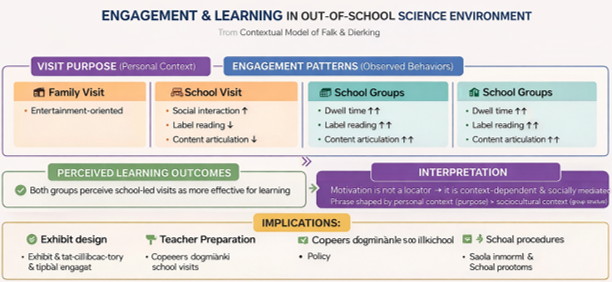
This study examines how visit purpose and visit configuration (family versus school groups) are associated with engagement patterns in an out-of-school science learnıng environment, specifically the Izmir Natural Wildlife Park. Drawing on Falk and Dierking’s Contextual Model of Learning, learning motivation is conceptualized not as a latent psychological trait but as a contextually expressed process observable through engagement behaviors. A qualitative case study design was employed with 119 middle school students aged 11–14. Data were collected through semi-structured interviews and systematic observations, focusing on dwell time, label reading, interaction patterns, and reported learning outcomes. Findings indicate that visit purpose differed substantially between groups: family visitors predominantly reported entertainment-oriented goals, whereas school-group visitors emphasized learning-oriented purposes. These orientations corresponded to distinct engagement patterns. School groups demonstrated longer exhibit dwell times, higher rates of label reading, and more frequent articulation of specific content knowledge. In contrast, family groups engaged more socially within their own units but interacted less with interpretive materials. Despite these differences, children in both groups perceived school-led visits as more effective for learning. Interpreted within the contextual model framework, the findings suggest that visit purpose (personal context) and group structure (sociocultural context) shape how engagement becomes behaviorally visible within the same physical environment. Rather than indicating differences in intrinsic motivation, the results highlight how motivational activation is mediated by social configuration and institutional framing. The study contributes to the literature on science education in out-of-school learning environments by comparatively examining family and school visits within a wildlife park context and by operationalizing learning motivation through observable engagement indicators. Implications for exhibit design, teacher preparation, and out-of-school science learning environments policy are discussed.
References
Affeldt, F., Tolppanen, S., Aksela, M., & Eilks, I. (2017). The potential of the non-formal educational sector for sup-porting chemistry learning and sustainability education for all students: A joint perspective from two cases in Finland and Germany. Chemistry Education Research and Practice, 18(1), 13–25. https://doi.org/10.1039/C6RP00212A
Anderson, D., M. Storksdieck, & Spock M. (2006). The long-term impacts of museum experiences. In Principle, In Practice: New Perspectives on Museums as Learning Institutions, J. Falk, L. Dierking, and S. Foutz, eds., 197–215. Walnut Creek: AltaMira Press.
Ash, D. (2004). Reflective scientific sense-making dialogue in two languages: The science in the dialogue and the dialogue in the science. Science Education, 88(6), 855–884. https://doi.org/10.1002/sce.20002
Baur, A. (2025). What Do We Know About Children’s And Adolescents’ Formal And Non-Formal Learning In The Zoo? A Systematic Literature Review. Animals, 15(24), 3533. https://doi.org/10.3390/ANI15243533
Braun, V., & Clarke, V. (2006). Using Thematic Analysis In Psychology. Qualitative research in psychology, 3(2), 77–101. https://doi.org/10.1191/1478088706QP063OA
Briseño-Garzón, A., Anderson, D., & Anderson, A. (2007). Entry and Emergent Agendas of Adults Visiting an Aquar-ium in Family Groups. Visitor Studies, 10(1), 73–89. https://doi.org/10.1080/10645570701263461
Callanan, M. A., Legare, C. H., Sobel, D. M., Jaeger, G. J., Letourneau, S. M., McHugh, S. R., Willard, A. K., & others. (2020). Exploration, explanation, and parent–child interaction in museums. Monographs of the Society for Research in Child Development, 85(1), 1–109. https://doi.org/10.1111/mono.12412
Çolakoğlu, J., Steegh, A., & Parchmann, I. (2023). Reimagining Informal STEM Learning Opportunities To Foster STEM Identity Development in Underserved Learners. Frontiers In Education, 8, 1082747. https://doi.org/10.3389/FEDUC.2023.1082747
Diamond, J. (1986). The Behavior of Family Science Museums. Curator, 29(2), 139-154. https://doi.org/10.1111/j.2151-6952.1986.tb01434.x
Eshach, H. (2007). Bridging in-school and out-of-school learning: Formal, non-formal, and informal education. Journal of Science Education and Technology, 16(2), 171–190. https://doi.org/10.1007/s10956-006-9027-1
Falk, J. H., & Dierking, L. (1997). Guest Editorial: Introduction. Science Education, 81(6), 629-631.
Falk, J. H., & Dierking, L. D. (2013). The museum experience revisited. Routledge. https://doi.org/10.4324/9781315417851
Falk, J. H., Scoot, C., Dierking, L., Rennie, L., & Jones, M. C. (2004). Interactives and Visitor Learning. Curator, 47(2), 171-192. https://doi.org/10.1111/j.2151-6952.2004.tb00116.x
Franse, R. K., Van Schijndel, T. J. P., Plankman, T. I., & Raijmakers, M. E. J. (2021). Families’ Experiments And Conversations At An Open-Ended Exhibit In A Science Museum: Individual Characteristics And The Influ-ence Of Minimal Guidance Strategies. Science Education, 105(4), 707–742. https://doi.org/10.1002/SCE.21620
Griffin, J., & Symington, D. (1997). Moving from Task-Oriented to Learning-Oriented Strategies on School Excur-sions to Museums. John Wiley & Sons, 763-779.
Guralp, G., McHugh, M., & Hayes, S. (2024). Non-formal science education: Moving towards more inclusive peda-gogies for diverse classrooms. Center for Educational Policy Studies Journal, 14(1), 105–142. https://doi.org/10.26529/cepsj.1707
Izmir Natural Wildlife Park. (2012). Retrieved May 14, 2017, from http://www.izmirdogalyasamparki.org.tr/.
Ji, J., Anderson, D., & Rodewald, P. (2026). Adult Family Members’ Roles ilincon Mediating Children’s Visits At A Chinese Science Museum. Museum Management and Curatorship, 41(4), 695–716. HTTPS://DOI.ORG/10.1080/09647775.2025.2467705
Lewalter, D., Neubauer, K., & Moser, S. (2025). Self-regulated STEM learning in museums—the role of learner char-acteristics and visit-related activities in school. International Journal of STEM Education, 12, 56. https://doi.org/10.1186/s40594-025-00577-9
Letourneau, S. M., Meisner, R., & Sobel, D. M. (2021). Effects Of Facilitation Vs. Exhibit Labels On Caregiver-Child Interactions At A Museum Exhibit. Frontiers In Psychology, 12, 637067. https://doi.org/10.3389/FPSYG.2021.637067
Lincoln, Y. S., & Guba, E. G. (1985). Naturalistic Inquiry. Sage.
Manyukhina, Y., Haywood, N., Davies, K., & Wyse, D. (2024). Young Children’s Agency In The Science Museum: Insights From The Use Of Storytelling In Object-Rich Galleries. International Journal Of Science Educa-tion, Part B, 14(2), 177–193. https://doi.org/10.1080/21548455.2023.2244645
Mcnally, X., Webb, T. L., Smith, C., Moss, A., & Gibson-Miller, J. (2025). A Meta-Analysis Of The Effect Of Visiting Zoos And Aquariums On Visitors’ Conservation Knowledge, Beliefs, And Behavior. Conserva-tion Biology, 39, E14237. https://doi.org/10.1111/COBI.14237
Merriam, S. (1988). Case study research in education: A qualitative approach. San Francisco: Jossey-Bass.
Miles, M. B., Huberman, A. M., & Saldaña, J. (2014). Qualitative Data Analysis: A Methods Sourcebook (3rd ED.). Sage.
Morag, O., & Tal, T. (2012). Assessing learning in the outdoors with the field trip in natural environments (FiNE) framework. International Journal of Science Education, 34(5), 745–777. https://doi.org/10.1080/09500693.2011.599046
Mujtaba, T., Lawrence, M., Oliver, M., & Reiss, M. J. (2018). Learning and engagement through natural history mu-seums. Studies in Science Education, 54(1), 41–67. https://doi.org/10.1080/03057267.2018.1442820
Orion, N. & Hofstein, A. (1994). Factors that influence learning during a scientific field trip in a natural environ-ment. Journal of Research in Science Teaching, 31(10), 1097–1119. https://doi.org/10.1002/tea.3660311005
Photo, P. (2024). Exploring the impact of zoological garden visits on primary school students’ science learning: A qualitative examination of experiential and outdoor learning effects. Journal of Outdoor and Environmen-tal Education, 28, 415–430. https://doi.org/10.1007/s42322-024-00175-3
Photo, P., & Shabalala, N. P. (2025). “I felt happy to see animals because they are kind.” How zoological environ-ments shape primary school students’ emotional engagement and interest in science learning. Journal of Biological Education, 1-23. https://doi.org/10.1080/00219266.2025.2523345
Patton, M. Q. (2015). Qualitative Research & Evaluation Methods (4TH ED.). Sage.
Rennie, L.J. & Johnston, D.J. (2004). The Nature of Learning and Its Implications for Research on Learning from Museums. Science Education, 88(S1), S4–S16. https://doi.org/10.1002/sce.20017
Roemer, L., Beniermann, A., Upmeier Zu Belzen, A., Moormann, A., & Ziegler, M. (2026). State Interest and Situa-tion Perception in The Museum: Systematic Links in an Educational Context. Contemporary Educational Psychology, 85, 102460. HTTPS://DOI.ORG/10.1016/J.CEDPSYCH.2026.102460
Schilbert, J., & Scheersoi, A. (2023). Learning outcomes measured in zoo and aquarium conservation education. Conservation biology, 37(1), E13891. https://doi.org/10.1111/COBI.13891
Sonnert, G., Reid, T., Sunbury, S., & Sadler, P. M. (2025). How do formal and informal science learning experiences during high school shape students’ career interest and STEM identity? International Journal of STEM Edu-cation, 12, 55. https://doi.org/10.1186/s40594-025-00568-w
Stocklmayer, S. M., Rennie, L. J., & Gilbert, J. K. (2010). The roles of the formal and informal sectors in the provi-sion of effective science education. Studies in Science Education, 46(1), 1–44. https://doi.org/10.1080/03057260903562284
Storksdieck, M. (2001). Differences in teachers’ and students’ museum field-trip experiences. Visitor Studies Today, 4(1), 8-12. https://www.researchgate.net/publication/265190064_Differences_in_teachers'_and_students'_museum_field-trip_experiences
Tezcan Akmehmet, K. & Ödekan, A. (2006). The Historical Development of Museum Education. ITU Journal, 3(1), 47-58.
Tolppanen, S., Vartiainen, J., Ikävalko, V.-M., & Aksela, M. (2015). Relevance of non-formal education in science education. In M. Juuti, K. Lavonen, R. Uitto, A. Byman, & J. Meisalo (Eds.), Science education research: En-gaging learners for a sustainable future (pp. 335–352). Springer. https://doi.org/10.1007/978-94-6300-175-5_18
Tunnicliffe, S.D. (2000). Conversations of family and primary school groups at robotic dinosaur exhibits in a muse-um: what do they talk about? International Journal of Science Education, 22(7), 739–754. https://doi.org/10.1080/09500690050044071
Türkmen, H. (2010). Informal (Outside the Classroom). A historical perspective on science education and its integra-tion into our education system. Çukurova Education Faculty Journal, 3(39), 46-59.
Türkmen, H. (2015). Adults' Visiting Agendas in Informal Learning Environments: The Example of Sasalı Natural Wildlife Park. Journal of European Education, 5(1), 15-22.
WANG, X., LI, Q., ZHANG, M., WANG, Y., & QIN, W. (2026). Lag Sequential Analysis of Parent–Child Interactions In Children’s Museums. Research in Science & Technological Education, 44(3), 1330–1352. HTTPS://DOI.ORG/10.1080/02635143.2025.2573197
Wolf, R. L., Dierkes, P. W., & Kleespies, M. W. (2025). Zoos as educational and conservation spaces: Perspectives from (future) teachers. Frontiers in Education, 10, 1680014. https://doi.org/10.3389/feduc.2025.1680014
Yun, S. T. (2023). A review of augmented reality for informal science learning: Design principles and visitor en-gagement. Visitor Studies, 26(2), 195–213. https://doi.org/10.1080/10645578.2022.2075205
Downloads
Published
How to Cite
Issue
Section
Categories
License
Copyright (c) 2026 Hakan Türkmen

This work is licensed under a Creative Commons Attribution 4.0 International License.