
Prospective primary school mathematics teachers’ professional knowledge of the ‘House of Quadrilaterals’
DOI:
https://doi.org/10.31129/LUMAT.14.1.2979Keywords:
hierarchical classification of quadrilaterals, mathematics teacher education, primary education, professional knowledge, prospective mathematics teachersAbstract
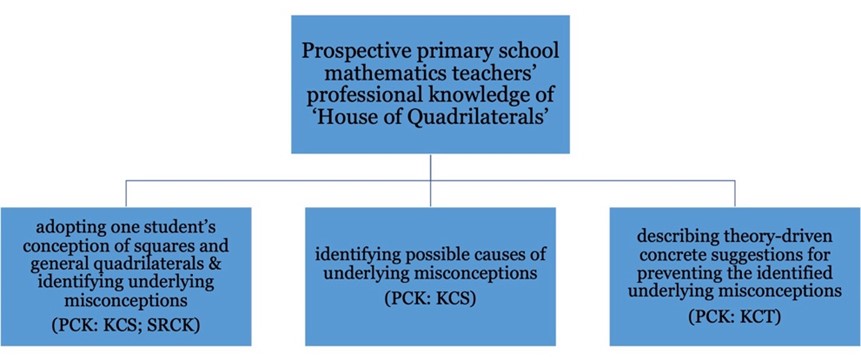
Mathematics teachers ought to possess solid knowledge of different school mathematics topics. Though classification of quadrilaterals (‘House of Quadrilaterals’) is an important and integral part of geometry curricula worldwide, research reports on learners’ difficulties understanding this particular geometric topic. The goal of this paper was to examine what professional knowledge on concept formation, using the example of the ‘House of Quadrilaterals’, prospective primary school mathematics teachers exhibited after attending a two-semester geometry course. For this purpose, an exploratory mix-methods study with 95 prospective primary school mathematics teachers was conducted. Capturing different facets of their professional knowledge of the aforementioned topic was based on analyzing a single task with three sub-tasks on concept formation. Descriptive statistics revealed satisfactory achievement with the majority of the prospective primary school mathematics teachers achieving more than half of the points. The results of the qualitative content analysis revealed an in-depth insight into a wide range of competence levels in all facets of professional knowledge. In the context of adopting one student’s conception of a square and (general) quadrilateral, identifying possible causes of underlying student’s misconceptions, and describing theory-driven suggestions for their prevention, deficits in prospective primary school mathematics teachers’ content and pedagogical content knowledge were evident. Especially, establishing links between specific sub-tasks and the subject-specific facets of professional knowledge proved to be challenging. Consequently, implications for mathematics teacher education pertaining to (re)design of courses that would support the development of prospective teachers’ professional knowledge, are provided. Furthermore, alternative study designs are discussed, which would enable a more in-depth assessment of prospective primary school mathematics teachers’ professional knowledge.
References
Ball, D. L., Thames, M. H., & Phelps, G. (2008). Content knowledge for teaching: What makes it special? Journal of Teacher Education, 59(5), 389–407. https://doi.org/10.1177/0022487108324554 DOI: https://doi.org/10.1177/0022487108324554
Baumert, J., & Kunter, M. (2011). Das Kompetenzmodell von COACTIV [The COACTIV competence model]. In M. Kunter, J. Baumert, W. Blum, U. Klusmann, S. Krauss, & M. Neubrand (Eds.), Professionelle Kompetenz von Lehrkräften: Ergebnisse des Forschungsprogramms COACTIV (pp. 29–53). Waxmann.
de Villiers, M. (1994). The role and function of a hierarchical classification of quadrilaterals. For the Learning of Mathematics, 14(1), 11–18.
Döring, N. (2023). Forschungsmethoden und Evaluation in den Sozial- und Humanwissenschaften [Research methods and evaluation in the social sciences and humanities] (6th ed.). Springer. https://doi.org/10.1007/978-3-662-64762-2 DOI: https://doi.org/10.1007/978-3-662-64762-2
Dreher, A., Lindmeier, A., Heinze, A., & Niemand, C. (2018). What kind of content knowledge do secondary mathematics teachers need? Journal für Mathematik-Didaktik, 39(2), 319–341. https://doi.org/10.1007/s13138-018-0127-2 DOI: https://doi.org/10.1007/s13138-018-0127-2
Fujita, T. (2008). Learners’ understanding of the hierarchical classification of quadrilaterals. Proceedings of the British Society for Research into Learning Mathematics, 28(2), 31–36.
Fujita, T., & Jones, K. (2007). Learners’ understanding of the definition and hierarchical classification of quadrilaterals: Toward a theoretical framing. Research in Mathematics Education, 9(1), 3–20. https://doi.org/10.1080/14794800008520167 DOI: https://doi.org/10.1080/14794800008520167
Heinze, A. (2002). „ … aber ein Quadrat ist kein Rechteck“ – Schülerschwierigkeiten beim Verwenden einfacher geometrischer Begriffe in Jahrgang 8 [„… but a square is not a rectangle“ – students‘ difficulties in using simple geometric terms in Grade 8]. Zentralblatt für Didaktik der Mathematik, 34(2), 51–55. https://doi.org/10.1007/BF02655704 DOI: https://doi.org/10.1007/BF02655704
Heinze, A., Dreher, A., Lindmeier, A., & Niemand, C. (2016). Akademisches versus schulbezogenes Fachwissen – ein differenzierteres Modell des fachspezifischen Professionswissens von angehenden Mathematiklehrkräften der Sekundarstufe [Academic versus school-related subject knowledge – a more differentiated model of subject-specific professional knowledge among prospective secondary school mathematics teachers]. Zeitschrift für Erziehungswissenschaft, 19(2), 329–349. https://doi.org/10.1007/s11618-016-0674-6 DOI: https://doi.org/10.1007/s11618-016-0674-6
Kawasaki, M. (1992). A study on the influences of visual imagery in the teaching of geometry. In K. Iwago (Ed.), The new perspective of mathematics education (pp. 160–171). Seibunsya.
Kuckartz, U. (2019). Qualitative text analysis: A systematic approach. In G. Kaiser & N. Presmeg (Eds.), Compendium for early career researchers in mathematics education (pp. 181–197). Springer International Publishing. https://doi.org/10.1007/978-3-030-15636-7_8 DOI: https://doi.org/10.1007/978-3-030-15636-7_8
Mayring, P. (2014). Qualitative content analysis: Theoretical foundation, basic procedures and software solution. Klagenfurt. DOI: https://doi.org/10.1007/978-94-017-9181-6_13
Monaghan, F. (2000). What difference does it make? Children’s views of the differences between some quadrilaterals. Educational Studies in Mathematics, 42(2), 179–196. https://doi.org/10.1023/A:1004175020394 DOI: https://doi.org/10.1023/A:1004175020394
Moore, R. C. (1994). Making the transition to formal proof. Educational Studies in Mathematics, 27(3), 249–266. https://doi.org/10.1007/BF01273731 DOI: https://doi.org/10.1007/BF01273731
Pickreign, J. (2007). Rectangle and rhombi: How well do pre-service teachers know them? Issues in the Undergraduate Mathematics Preparation of School Teachers, 1.
Reitz-Koncebovski, K., Kuzle, A., & Kortenkamp, U. (2022). Is there a number in-between, and if so, how many? Analysis of prospective primary teachers’ knowledge of rational numbers. In J. Hodgen, E. Geraniou, G. Bolondi, & F. Ferretti (Eds.), Twelfth Congress of the European Society for Research in Mathematics Education (CERME 12) (pp. 3251–3258). Free University of Bozen-Bolzano and ERME.
Shulman, L. S. (1986). Those who understand: Knowledge growth in teaching. Educational Researcher, 15(2), 4–14. https://doi.org/10.3102/0013189X015002004 DOI: https://doi.org/10.3102/0013189X015002004
Vinner, S. (1991). The role of definitions in the teaching and learning of mathematics. In D. Tall (Ed.), Advanced mathematical thinking (pp. 65–81). Springer Netherlands. https://doi.org/10.1007/0-306-47203-1_5 DOI: https://doi.org/10.1007/0-306-47203-1_5
Wahl, D. (2013). Lernumgebungen erfolgreich gestalten [Designing successful learning environments] (3rd ed.). Klinkhardt.
Weigand, H.-G. (2014). Begriffslernen und Begriffslehren [Concept learning and concept teaching]. In H.-G. Weigand, A. Filler, R. Hölzl, S. Kuntze, M. Ludwig, J. Roth, B. Schmidt-Thieme, & G. Wittmann (Eds.), Didaktik der Geometrie für die Sekundarstufe I (pp. 99–122). Springer Berlin Heidelberg. https://doi.org/10.1007/978-3-642-37968-0_6 DOI: https://doi.org/10.1007/978-3-642-37968-0_6
Weigand, H.-G. (2015). Begriffsbildung [Concept formation]. In R. Bruder, L. Hefendehl-Hebeker, B. Schmidt-Thieme, & H.-G. Weigand (Eds.), Handbuch der Mathematikdidaktik (pp. 255–278). Springer Berlin Heidelberg. https://doi.org/10.1007/978-3-642-35119-8_9 DOI: https://doi.org/10.1007/978-3-642-35119-8_9
Downloads
Additional Files
Published
How to Cite
Issue
Section
Categories
License
Copyright (c) 2026 Ana Kuzle

This work is licensed under a Creative Commons Attribution 4.0 International License.