
Academic resilience in science
An examination of high achievers from low socioeconomic backgrounds
DOI:
https://doi.org/10.31129/LUMAT.14.3.3105Keywords:
Educational equity, comparative analysis, low-socioeconomic status, science achievement, sociocultural contextAbstract
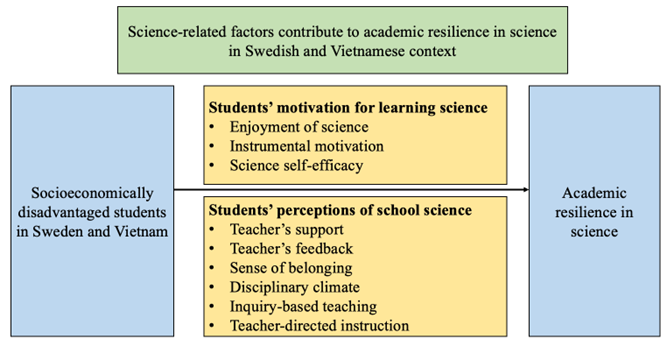
Research on academic resilience has gained attention for its potential to promote equitable opportunities, especially for socioeconomically disadvantaged students who face significant barriers. Yet, research on factors supporting academic resilience in science specifically across different cultural contexts remains limited. This study investigates academic resilience in science among secondary school students in two socio-culturally distinct countries, Sweden and Vietnam. It examines how students’ motivation to learn science and perceptions of school science differ between academically resilient and non-resilient students in each country. The analysis utilises data from the 2015 Programme for International Student Assessment (PISA) science cycle, involving 5,458 students from 202 Swedish schools and 5,826 students from 188 Vietnamese schools. The findings show a lower proportion of academically resilient students in Sweden (36.19%) compared to Vietnam (59.89%). Despite socio-cultural differences, both countries share common factors contributing to resilience in science, including enjoyment of science, science self-efficacy, teacher support, and a sense of belonging. However, several factors distinguishing resilient from non-resilient students vary between these countries, which are pertinent not only to students but also to teachers and their teaching approaches. This study underscores the importance of discipline-specific and contextually relevant approaches for fostering academic resilience in science education, particularly among disadvantaged youth. Adapting interventions to align with cultural and contextual needs can enhance equitable science learning outcomes.
References
Agasisti, T., Avvisati, F., Borgonovi, F., & Longobardi, S. (2018). Academic resilience: What schools and countries do to help disadvantaged students succeed in PISA. OECD Publishing. https://doi.org/10.1787/e22490ac-en
Agasisti, T., & Longobardi, S. (2017). Equality of educational opportunities, schools’ characteristics and resilient students: An empirical study of EU-15 countries using OECD-PISA 2009 data. Social Indicators Research, 134(3), 917–953. https://doi.org/10.1007/s11205-016-1464-5
Alivernini, F., Manganelli, S., & Lucidi, F. (2016). The last shall be the first: Competencies, equity and the power of resilience in the Italian school system. Learning and Individual Differences, 51, 19–28. https://doi.org/10.1016/j.lindif.2016.08.010
Blanchard, M. R., Southerland, S. A., Osborne, J. W., Sampson, V. D., Annetta, L. A., & Granger, E. M. (2010). Is inquiry possible in light of accountability?: A quantitative comparison of the relative effectiveness of guided inquiry and verification laboratory instruction. Science Education, 94(4), 577–616. https://doi.org/10.1002/sce.20390
Bøe, M. V., & Henriksen, E. K. (2013). Love it or leave it: Norwegian students’ motivations and expectations for postcompulsory physics. Science Education, 97(4), 550–573. https://doi.org/10.1002/sce.21068
Bronfenbrenner, U. (1979). The ecology of human development: Experiments by nature and design. Harvard University Press.
Camasso, M. J., & Jagannathan, R. (2017). Improving academic outcomes in poor urban schools through nature-based learning. Cambridge Journal of Education, 48(2), 263–277. https://doi.org/10.1080/0305764X.2017.1324020
Cerna, L., Brussino, O., & Mezzanotte, C. (2021). The resilience of students with an immigrant background: An update with PISA 2018 (OECD Education Working Papers No. 261; OECD Education Working Papers, Vol. 261). https://doi.org/10.1787/e119e91a-en
Chen, S., Binning, K. R., Manke, K. J., Brady, S. T., McGreevy, E. M., Betancur, L., Limeri, L. B., & Kaufmann, N. (2021). Am I a Science Person? A Strong Science Identity Bolsters Minority Students’ Sense of Belonging and Performance in College. Personality and Social Psychology Bulletin. https://doi.org/10.1177/0146167220936480
Cheung, K. (2017). The effects of resilience in learning variables on mathematical literacy performance: A study of learning characteristics of the academic resilient and advantaged low achievers in Shanghai, Singapore, Hong Kong, Taiwan and Korea. Educational Psychology, 37(8), 965–982. https://doi.org/10.1080/01443410.2016.1194372
Cheung, K., Sit, P., Soh, K., Ieong, M., & Mak, S. (2014). Predicting academic resilience with reading engagement and demographic variables: Comparing Shanghai, Hong Kong, Korea, and Singapore from the PISA perspective. The Asia-Pacific Education Researcher, 23(4), 895–909. https://doi.org/10.1007/s40299-013-0143-4
Chuang, S.-F. (2012). Different instructional preferences between Western and Far East Asian adult learners: A case study of graduate students in the USA. Instructional Science, 40(3), 477–492. https://doi.org/10.1007/s11251-011-9186-1
Clavel, J. G., García Crespo, F. J., & Sanz San Miguel, L. (2022). Rising above their circumstances: What makes some disadvantaged East and South-East Asian students perform far better in science than their background predicts? Asia Pacific Journal of Education, 42(4), 714–729. https://doi.org/10.1080/02188791.2021.1886905
Cohen, J. (2013). Statistical power analysis for the behavioral sciences. routledge.
Coley, R. L., Kruzik, C., & Votruba-Drzal, E. (2020). Do family investments explain growing socioeconomic disparities in children’s reading, math, and science achievement during school versus summer months? Journal of Educational Psychology, 112(6), 1183. https://doi.org/10.1037/edu0000427
Cordero, J. M., & Mateos-Romero, L. (2021). Exploring factors related with resilience in primary education: Evidence from European countries. Studies in Educational Evaluation, 70, 101045. https://doi.org/10.1016/j.stueduc.2021.101045
Dang, H.-A., Glewwe, P., Lee, J., & Vu, K. (2023). What Explains Vietnam’s Exceptional Performance in Education Relative to Other Countries? Analysis of the 2012, 2015, and 2018 PISA Data. Economics of Education Review, 96, 102434. https://doi.org/10.1016/j.econedurev.2023.102434
Fagerland, M. W. (2012). t-tests, non-parametric tests, and large studies—A paradox of statistical practice? BMC Medical Research Methodology, 12(1), 78. https://doi.org/10.1186/1471-2288-12-78
Fagerland, M. W., & Sandvik, L. (2009). Performance of five two-sample location tests for skewed distributions with unequal variances. Contemporary Clinical Trials, 30(5), 490–496. https://doi.org/10.1016/j.cct.2009.06.007
Ferguson, D., & Martin-Dunlop, C. (2021). Uncovering stories of resilience among successful African American women in STEM. Cultural Studies of Science Education, 16(2), 461–484. https://doi.org/10.1007/s11422-020-10006-8
Gartland, D., Bond, L., Olsson, C. A., Buzwell, S., & Sawyer, S. M. (2011). Development of a multi-dimensional measure of resilience in adolescents: The Adolescent Resilience Questionnaire. BMC Medical Research Methodology, 11(1), 1–10. https://doi.org/10.1186/1471-2288-11-134
Hofstede. (2022). Comparison index. http://www.hofstede-insights.com/
Hofstede, G. (2011). Dimensionalizing Cultures: The Hofstede Model in Context. Online Readings in Psychology and Culture, 2(1). https://doi.org/10.9707/2307-0919.1014
Högberg, B., Lindgren, J., Johansson, K., Strandh, M., & Petersen, S. (2021). Consequences of school grading systems on adolescent health: Evidence from a Swedish school reform. Journal of Education Policy, 36(1), 84–106. https://doi.org/10.1080/02680939.2019.1686540
Jensen, E. (2009). Teaching with poverty in mind: What being poor does to kids’ brains and what schools can do about it. AScD.
Jiang, T., Qian, H. F., Li, F. Q., & Wang, T. J. (2024). Typologies of secondary school student academic resilience in science with classroom and school context predictors. International Journal of Science Education, 1–30. https://doi.org/10.1080/09500693.2024.2321471
Johansson, S., Yang Hansen, K., & Thorsen, C. (2023). A modeling approach to identify academically resilient students: Evidence from PIRLS 2016. European Journal of Psychology of Education. https://doi.org/10.1007/s10212-023-00711-7
Kjeldsen, C. C., Nilsen, T., Hiltunen, J., & Teig, N. (2024). Introduction: Student Achievement and Equity Over Time in the Nordic Countries. In Effective and Equitable Teacher Practice in Mathematics and Science Education: A Nordic Perspective Across Time and Groups of Students (pp. 1–19). Springer. https://doi.org/10.1007/978-3-031-49580-9_1
Korous, K. M., Causadias, J. M., Bradley, R. H., Luthar, S. S., & Levy, R. (2022). A systematic overview of meta-analyses on socioeconomic status, cognitive ability, and achievement: The need to focus on specific pathways. Psychological Reports, 125(1), 55–97. https://doi.org/10.1177/0033294120984127
Kuldas, S., & Foody, M. (2022). Neither Resiliency-Trait nor Resilience-State: Transactional Resiliency/e. Youth & Society, 54(8), 1352–1376. https://doi.org/10.1177/0044118X211029309
Lau, K., & Lam, T. Y. (2017). Instructional practices and science performance of 10 top-performing regions in PISA 2015. International Journal of Science Education, 39(15), 2128–2149. https://doi.org/10.1080/09500693.2017.1387947
Li, H., Martin, A. J., & Yeung, W.-J. J. (2017). Academic risk and resilience for children and young people in Asia. Educational Psychology, 37(8), 921–929. https://doi.org/10.1080/01443410.2017.1331973
Liu, J., Peng, P., Zhao, B., & Luo, L. (2022). Socioeconomic status and academic achievement in primary and secondary education: A meta-analytic review. Educational Psychology Review, 34(4), 2867–2896. https://doi.org/10.1007/s10648-022-09689-y
Luthans, F., Avolio, B. J., Avey, J. B., & Norman, S. M. (2007). Positive psychological capital: Measurement and relationship with performance and satisfaction. Personnel Psychology, 60(3), 541–572. https://doi.org/10.1111/j.1744-6570.2007.00083.x
Luthar, S. S., Cicchetti, D., & Becker, B. (2000). The Construct of Resilience A Critical Evaluation and Guidelines for Future Work. Child Development, 71(3). https://doi.org/10.1111/1467-8624.00164
Ma, X. (2003). Sense of belonging to school: Can schools make a difference? The Journal of Educational Research, 96(6), 340–349. https://doi.org/10.1080/00220670309596617
Masten, A. S., Narayan, A. J., & Wright, M. O. (2023). Resilience processes in development: Multisystem integration emerging from four waves of research. In Handbook of resilience in children (pp. 19–46). Springer. https://doi.org/10.1007/978-3-031-14728-9_2
Mate, S., Mcdonald, M., Morgan, A., Hoang, D.-N., Das, M., & Dinh, N. (2017). Influences on career identity in Vietnamese students at an international university. Australian Journal of Career Development, 26(1), 24–31.
Nguyen, H. T. (2019). Ethnic gaps in child education outcomes in Vietnam: An investigation using Young Lives data. Education Economics, 27(1), 93–111. https://doi.org/10.1080/09645292.2018.1444147
Nilsen, T., & Teig, N. (2024). Discussions of Findings on Teacher Practice Across Countries, Time, and Chapters. Effective and Equitable Teacher Practice in Mathematics and Science Education, 277. https://doi.org/10.1007/978-3-031-49580-9_10
OECD. (2016). PISA 2015 Results (Volume I): Excellence and Equity in Education. OECD. https://doi.org/10.1787/9789264266490-en
OECD. (2017). PISA 2015 Assessment and Analytical Framework: Science, Reading, Mathematic, Financial Literacy and Collaborative Problem Solving. OECD Publishing. https://doi.org/10.1787/9789264281820-en
Özden, C., & Atasoy, R. (2020). Socioeconomically Disadvantaged and Resilient Students’ Characteristics and Their Perceptions about School. International Journal of Progressive Education, 16(5), 70–89. https://doi.org/10.29329/ijpe.2020.277.5
Rudd, G., Meissel, K., & Meyer, F. (2021). Measuring academic resilience in quantitative research: A systematic review of the literature. Educational Research Review, 34, 100402. https://doi.org/10.1016/j.edurev.2021.100402
Ruiz-Primo, M. A., & Li, M. (2013). Analyzing Teachers’ Feedback Practices in Response to Students’ Work in Science Classrooms. Applied Measurement in Education, 26(3), 163–175. https://doi.org/10.1080/08957347.2013.793188
Rutter, M. (2012). Resilience as a dynamic concept. Dev Psychopathol, 24(2), 335–344. https://doi.org/10.1017/s0954579412000028
Ryan, R. M., & Deci, E. L. (2000). Self-determination theory and the facilitation of intrinsic motivation, social development, and well-being. American Psychologist, 55(1), 68. http://dx.doi.org/10.1037/0003-066X.55.1.68
Sandoval-Hernández, A., & Białowolski, P. (2016). Factors and conditions promoting academic resilience: A TIMSS-based analysis of five Asian education systems. Asia Pacific Education Review, 17(3), 511–520. https://doi.org/10.1007/s12564-016-9447-4
Scherer, R. (2020). The case for good discipline? Evidence on the interplay between disciplinary climate, socioeconomic status, and science achievement from PISA 2015. https://doi.org/10.1007/978-3-030-61648-9_8
She, H., Lin, H., & Huang, L. (2019). Reflections on and implications of the Programme for International Student Assessment 2015 (PISA 2015) performance of students in Taiwan: The role of epistemic beliefs about science in scientific literacy. Journal of Research in Science Teaching, 56(10), 1309–1340. https://doi.org/10.1002/tea.21553
Siebecke, D. E. (2023). Does social well-being predict academic resilience and achievement? Analysis of Swedish PISA 2018 data. European Journal of Psychology of Education. https://doi.org/10.1007/s10212-023-00762-w
Sirin, S. R. (2005). Socioeconomic Status and Academic Achievement—A Meta-Analytic Review of Research. Review of Educational Research, 75(3), 417–453. https://doi.org/10.3102/00346543075003417
Sjøberg, S. (2018). The power and paradoxes of PISA: Should Inquiry-Based Science Education be sacrificed to climb on the rankings? Nordic Studies in Science Education, 14(2), 186–202. https://doi.org/10.5617/nordina.6185
Skolverket. (2015). To respond or not to respond: The motivation of Swedish students in taking the PISA test. https://www.skolverket.se/publikationsserier/aktuella-analyser/2015/to-respond-or-not-to-respond.-the-motivation-of-swedish-students-in-taking-the-pisa-test
Stevenson, A. D., Gallard Martínez, A. J., Brkich, K. L., Flores, B. B., Claeys, L., & Pitts, W. (2019). Latinas’ heritage language as a source of resiliency: Impact on academic achievement in STEM fields. Cultural Studies of Science Education, 14(1), 1–13. https://doi.org/10.1007/s11422-016-9789-6
Swedish National Agency for Education (Skolverket). (2012). Educational equity in the Swedish school system? A quantitative analysis of equity over time. https://www.skolverket.se/download/18.6bfaca41169863e6a65b2f3/1553965825706/pdf3322.pdf
Teig, N., & Nilsen, T. (2022). Profiles of instructional quality in primary and secondary education: Patterns, predictors, and relations to student achievement and motivation in science. Studies in Educational Evaluation, 74, 101170. https://doi.org/10.1016/j.stueduc.2022.101170
Thorsen, C., Yang Hansen, K., & Johansson, S. (2021). The mechanisms of interest and perseverance in predicting achievement among academically resilient and non‐resilient students: Evidence from Swedish longitudinal data. British Journal of Educational Psychology, 91(4), 1481–1497. https://doi.org/10.1111/bjep.12431
Triandis, H. C. (2018). Individualism and collectivism. Routledge.
Truong, N., & Triventi, M. (2025). How do adverse family characteristics and shock events shape children’s educational outcomes in Vietnam?–Evidence from Young Lives surveys. International Journal of Educational Development, 117, 103375. https://doi.org/10.1016/j.ijedudev.2025.103375
Volante, L., & Klinger, D. A. (2022). PISA, global reference societies, and policy borrowing: The promises and pitfalls of ‘academic resilience’. Policy Futures in Education, 21(7), 755–764. https://doi.org/10.1177/14782103211069002
Wang, F., King, R. B., Fu, L., Chai, C.-S., & Leung, S. O. (2023). Overcoming adversity: Exploring the key predictors of academic resilience in science. International Journal of Science Education, 1–25. https://doi.org/10.1080/09500693.2023.2231117
Wang, F., King, R. B., & Leung, S. O. (2022). Beating the odds: Identifying the top predictors of resilience among Hong Kong students. Child Indicators Research, 15(5), 1921–1944. https://doi.org/10.1007/s12187-022-09939-z
Wang, J., & Lin, J. (2019). Traditional Chinese views on education as perceived by international students in China: International student attitudes and understandings. Journal of Studies in International Education, 23(2), 195–216. https://doi.org/10.1177/1028315318797356
Wang, M. C., Haertal, G. D., & Walgberg, H. J. (1994). Educational resilience in inner-city. In M. C. Wang & E. W. Gordon (Eds), Educational resilience in inner-city America: Challenges and prospects (pp. 45–72). Lawrence Erlbaunm Associates.
Wang, X. S., Perry, L. B., Malpique, A., & Ide, T. (2023). Factors predicting mathematics achievement in PISA: A systematic review. Large-Scale Assessments in Education, 11(1), 24. https://doi.org/10.1186/s40536-023-00174-8
Wang, Z., & Chi, S. (2023). Pathways to low-SES student success in science: a fuzzy-set qualitative comparative analysis. International Journal of Science Education, 1–27. 935–960 https://doi.org/10.1080/09500693.2023.2266788
Yang Hansen, K., & Gustafsson, J.-E. (2016). Causes of educational segregation in Sweden–school choice or residential segregation. Educational Research and Evaluation, 22(1–2), 23–44. https://doi.org/10.1080/13803611.2016.1178589
Ye, W., Strietholt, R., & Blömeke, S. (2021). Academic resilience: Underlying norms and validity of definitions. Educational Assessment, Evaluation and Accountability, 33(1), 169–202. https://doi.org/10.1007/s11092-020-09351-7
Downloads
Additional Files
Published
How to Cite
Issue
Section
License
Copyright (c) 2026 Nhu Truong, Nani Teig, Anna Danielsson, Per Anderhag

This work is licensed under a Creative Commons Attribution 4.0 International License.