
Matemaattisen sanaston osaaminen suomea toisena kielenään puhuvilla esiopetusikäisillä lapsilla
DOI:
https://doi.org/10.31129/LUMAT.14.2.3316Keywords:
matemaattinen sanasto, varhaiskasvatus, esiopetusikäiset, suomi toisena kielenä, mathematical vocabulary, finnish language learners, kindergartners, early childhood educationAbstract
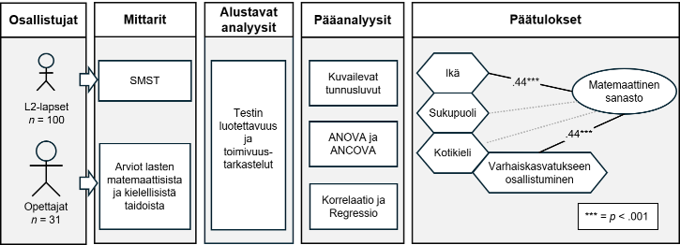
Suomea toisena kielenään (L2) oppivien lasten matemaattiset taidot kehittyvät selvästi suomea äidinkielenään (L1) puhuvia heikommin ja matemaattinen sanasto on taitojen kehittymisen kannalta keskeisessä asemassa. Tässä tutkimuksessa selvitettiin esiopetusikäisten L2-lasten matemaattisen sanaston osaamista sekä sen yhteyttä lapsen ikään, sukupuoleen, kotikieleen ja varhaiskasvatukseen osallistumisen kestoon. Aineisto kerättiin esiopetusikäisiltä L2-lapsilta (N = 100) pääkaupunkiseudulla. Matemaattisen sanaston osaamista tarkasteltiin SMST-kuvasanavarastotestin avulla. Tulokset osoittavat, että matemaattisen sanaston osaamisessa on havaittavissa selkeitä yksilöiden välisiä eroja, joita selittivät osin lasten ikä ja varhaiskasvatukseen osallistumisen kesto. Tyttöjen ja poikien sanaston osaamisessa ei ollut tilastollisesti merkitseviä eroja, kun iän vaikutus vakioitiin. Kotikieliryhmät eivät eronneet toisistaan tilastollisesti merkitsevästi matemaattisen sanaston osaamisessa. Tutkimus antaa uutta tietoa esiopetusikäisten L2-lasten matemaattisen sanaston osaamisen yksilöllisistä eroista, mitä voidaan hyödyntää heidän matemaattisten taitojen kehityksen tukemisessa ja tuen tarpeen arvioinnissa.
Mathematical vocabulary in kindergarten-aged children who speak Finnish as a second language
Children learning Finnish as a second language (L2) have weaker mathematical skills than native Finnish speakers, and mathematical vocabulary plays a key role in this development. In this study, we investigated the mathematical vocabulary of kindergarten-aged L2 children and analysed the relationship between age, gender, home language and duration of participation in early childhood education and mathematical vocabulary. The data were collected from kindergarten-aged L2-children (N = 100) from kindergartens in the Helsinki metropolitan area. The mathematical vocabulary was assessed using the SMST Picture Vocabulary Test. Results show clear individual differences in mathematical vocabulary knowledge, partially explained by children’s age and the duration of their participation in Finnish early childhood education. There were no statistically significant differences in mathematical vocabulary between girls and boys after controlling for the effect of age. There were no differences in the home language groups in mathematical vocabulary. This study provides new evidence on individual differences in the mathematical vocabulary knowledge of kindergarten-aged L2 children, which can be used to support the development of their mathematical skills and to evaluate the need for educational support.
References
Arvonen, A., Katva, L., & Nurminen, A. (2010). Maahanmuuttajien oppimisvaikeuksien tunnistaminen. PS-kustannus.
Bailey, J., Ullery, M. A., Futterer, J., Mullins, C., Delgado, C., Custode, S., Gruen, R., Pena, A., Gonzalez, A., & Bulotsky-Shearer, R. J. (2024). Direct and interactive effects of attendance rates on growth in language, literacy and mathematics skills for children enrolled in voluntary preschool programs. Early Childhood Research Quarterly, 68, 112–122. https://doi.org/10.1016/j.ecresq.2024.04.009
Berger, C., Angonin, S., & Lafay, A. (2026). Mathematical vocabulary in preschool children: Effects of linguistic and socio-economic factors on the production and comprehension of quantitative and spatial words and concepts. Journal of Experimental Child Psychology, 263, 106416. https://doi.org/10.1016/j.jecp.2025.106416
Bezuidenhout, H. S., Vanhala, A., Fonseca, K., Henning, E., Korhonen, J., & Aunio, P. (2025). Development of a Mathematics Vocabulary Test: Evidence of validity and reliability in a multilingual context. Developmental Psychology. https://doi.org/10.1037/dev0001941
Bleses, D., Moos, M., Purpura, D. J., & Dale, P. S. (2023). General and math vocabulary contributions to early numeracy skills in a large population-representative sample. Frontiers in Developmental Psychology, 1. https://doi.org/10.3389/fdpys.2023.1279691
Clements, D. H., & Sarama, J. (2021). Learning and teaching early math: The learning trajectories approach (3. painos). Routledge.
Cummins, J. (2000). Academic Language Learning, Transformative Pedagogy, and Information Technology: Towards a Critical Balance. TESOL Quarterly, 34(3), 537. https://doi.org/10.2307/3587742
Cummins, J., & Yee-Fun, E. M. (2007). Academic Language. Teoksessa J. Cummins & C. Davison (Toim.), International Handbook of English Language Teaching (s. 797–810). Springer US. https://doi.org/10.1007/978-0-387-46301-8_53
Devlin, D., Moeller, K., & Sella, F. (2022). The structure of early numeracy: Evidence from multi-factorial models. Trends in Neuroscience and Education, 26, 100171. https://doi.org/10.1016/j.tine.2022.100171
Duncan, G. J., Dowsett, C. J., Claessens, A., Magnuson, K., Huston, A. C., Klebanov, P., Pagani, L. S., Feinstein, L., Engel, M., Brooks-Gunn, J., Sexton, H., Duckworth, K., & Japel, C. (2007). School Readiness and Later Achievement. Developmental psychology, 43(6), 1428–1446. https://doi.org/10.1037/0012-1649.43.6.1428
Dunn, L. M., & Dunn, L. M. (1997). Peabody Picture Vocabulary Test—Third Edition (PPVT-III). https://doi.org/https://doi.org/10.1037/t15145-000
Fenson, L., Dale, P. S., Reznick, J. S., Bates, E., Thal, D. J., Pethick, S. J., Tomasello, M., Mervis, C. B., & Stiles, J. (1994). Variability in Early Communicative Development. Monographs of the Society for Research in Child Development, 59(5). https://doi.org/10.2307/1166093
Field, A. P., Field, Z., & Miles, J. (2012). Discovering statistics using R. Sage.
Fisher, E. (2017). A Systematic Review and Meta-Analysis of Predictors of Expressive-Language Outcomes Among Late Talkers. Journal of Speech, Language, and Hearing Research, 60(10), 2935–2948. https://doi.org/10.1044/2017_JSLHR-L-16-0310
Foster, M. E., Anthony, J. L., Zucker, T. A., & Branum-Martin, L. (2019). Prediction of English and Spanish kindergarten mathematics from English and Spanish cognitive and linguistic abilities in Hispanic dual language learners. Early Childhood Research Quarterly, 46, 213–227. https://doi.org/10.1016/j.ecresq.2018.02.007
Heimo, H. (1993). Boehmin peruskäsitetesti- suomalaisen laitoksen käsikirja. Psykologien kustannus.
Joutsenlahti, J., & Tossavainen, T. (2018). Matemaattisen ajattelun kielentäminen ja siihen ohjaaminen koulussa. Teoksessa Matematiikan opetus ja oppiminen (1. painos). Niilo Mäki Instituutti.
Jylänki, P., Sipinen, E., Mbay, T., Sääkslahti, A., & Aunio, P. (2023). Combining Numerical Relational and Fundamental Motor Skills to Improve Preschoolers’ Early Numeracy: A Pilot Intervention Study. International Journal of Early Childhood, 55(1), 131–154. https://doi.org/10.1007/s13158-022-00329-8
Karagiannakis, G., & Noël, M.-P. (2020). Mathematical profile test: A preliminary evaluation of an online assessment for mathematics skills of children in grades 1-6. Behavioral Sciences, 10(8). https://doi.org/10.3390/BS10080126
King, Y. A., & Purpura, D. J. (2021). Direct numeracy activities and early math skills: Math language as a mediator. Early Childhood Research Quarterly, 54, 252–259. https://doi.org/10.1016/j.ecresq.2020.09.012
Kiss, A. J., Nelson, G., & Christ, T. J. (2019). Predicting Third-Grade Mathematics Achievement: A Longitudinal Investigation of the Role of Early Numeracy Skills. Learning Disability Quarterly, 42(3), 161–174. https://doi.org/10.1177/0731948718823083
Kuukka, K., & Metsämuuronen, J. (2016). Perusopetuksen päättövaiheen suomi toisena kielenä (S2) -oppimäärän oppimistulosten arviointi 2015. Kansallinen koulutuksen arviointikeskus.
Laitala, M. (2023). Lauran päivä: Suomi toisena kielenä: Kartoitusaineisto esiopetukseen. Opetushallitus.
Lariviere, D. O., Arsenault, T. L., & Payne, S. B. (2024). A literature review: Mathematics vocabulary intervention for students with mathematics difficulty. School Science and Mathematics. https://doi.org/10.1111/ssm.12684
Lesaux, N. K., & Siegel, L. S. (2003). The Development of Reading in Children Who Speak English as a Second Language. Developmental Psychology, 39(6), 1005–1019. https://doi.org/10.1037/0012-1649.39.6.1005
Lin, X., Peng, P., & Zeng, J. (2021). Understanding the Relation between Mathematics Vocabulary and Mathematics Performance: A Meta-Analysis. The Elementary school journal, 121(3), 504–540. https://doi.org/10.1086/712504
Lin, X., & Powell, S. R. (2024). Development of a Fraction Vocabulary Measure. Assessment for Effective Intervention, 49(3), 138–147. https://doi.org/10.1177/15345084231202407
Luomaniemi, K., Kankaanpää, S., & Hannula-Sormunen, M. (2023). Suosituksia monikielisten lasten varhaisten matemaattisten taitojen tukemiseen – Temaattinen synteesi. Journal of Early Childhood Education Research, 12(3), Article 3. https://doi.org/10.58955/jecer.126173
Luomaniemi, K., Mattinen, A., McMullen, J., Sorariutta, A., & Hannula-Sormunen, M. (2021). The Effects of a SFON-Based Early Numeracy Program on Multilingual Children’s Early Numeracy and Oral Language Skills. Journal of Cognitive Education and Psychology, 20(2), 138–160. https://doi.org/10.1891/JCEP-D-20-00006
Mononen, R., Aunio, P., Korhonen, J., Tapola, A., & Väisänen, E. (2017). Matemaattiset oppimisvaikeudet. PS-kustannus.
Monroe, E. E., & Panchyshyn, R. (1995). Vocabulary Considerations for Teaching Mathematics. Childhood education, 72(2), 80–83. https://doi.org/10.1080/00094056.1996.10521849
Moschkovich, J. N. (2015). Academic literacy in mathematics for English Learners. The Journal of Mathematical Behavior, 40, 43–62. https://doi.org/10.1016/j.jmathb.2015.01.005
Nunnally, J. C., & Bernstein, I. H. (1994). Psychometric theory (3. painos). McGraw-Hill.
Opetushallitus. (2014a). Esiopetuksen opetussuunnitelmien perusteet. Opetushallitus. https://www.oph.fi/fi/koulutus-ja-tutkinnot/esiopetuksen-opetussuunnitelmien-perusteet
Opetushallitus. (2014b). Perusopetuksen opetussuunnitelman perusteet. Opetushallitus. https://www.oph.fi/sites/default/files/documents/perusopetuksen_opetussuunnitelman_perusteet_2014.pdf
Opetushallitus. (2016). Oma kieli—Oma mieli: Oppilaan oma äidinkieli. Opetushallitus.
Opetushallitus. (2022). Varhaiskasvatussuunnitelman perusteet. Opetushallitus. https://www.oph.fi/fi/tilastot-ja-julkaisut/julkaisut/varhaiskasvatussuunnitelman-perusteet-2022
Outhwaite, L. A., Aunio, P., Leung, J. K. Y., & Van Herwegen, J. (2024). Measuring Mathematical Skills in Early Childhood: A Systematic Review of the Psychometric Properties of Early Maths Assessments and Screeners. https://doi.org/10.31234/osf.io/hk37b
Peng, P., Lin, X., Ünal, Z. E., Lee, K., Namkung, J., Chow, J., & Sales, A. (2020). Examining the Mutual Relations Between Language and Mathematics: A Meta-Analysis. Psychological bulletin, 146(7), 595–634. https://doi.org/10.1037/bul0000231
Powell, S. R., Driver, M. K., Roberts, G., & Fall, A.-M. (2017). An analysis of the mathematics vocabulary knowledge of third- and fifth-grade students: Connections to general vocabulary and mathematics computation. Learning and individual differences, 57, 22–32. https://doi.org/10.1016/j.lindif.2017.05.011
Powell, S. R., & Nelson, G. (2017). An Investigation of the Mathematics-Vocabulary Knowledge of First-Grade Students. The Elementary School Journal, 117(4), 664. (1908302096). https://www.jstor.org/stable/26546659
Purpura, D., Logan, J. A. R., Hassinger-Das, B., & Napoli, A. R. (2017). Why Do Early Mathematics Skills Predict Later Reading? The Role of Mathematical Language. Developmental psychology, 53(9), 1633–1642. https://doi.org/10.1037/dev0000375
Purpura, D., & Reid, E. E. (2016). Mathematics and language: Individual and group differences in mathematical language skills in young children. Early Childhood Research Quarterly, 36(NA), 259–268. https://doi.org/10.1016/j.ecresq.2015.12.020
Riccomini, P. J., Smith, G. W., Hughes, E. M., & Fries, K. M. (2015). The Language of Mathematics: The Importance of Teaching and Learning Mathematical Vocabulary. Reading & writing quarterly, 31(3), 235–252. https://doi.org/10.1080/10573569.2015.1030995
Räsänen, P. (2011). Matematiikan perusteiden kouluoppimisen sanasto. LukiMat. https://lukimat.fi/matematiikka/monimat/matematiikan-sanasto/matematiikan-sanasto.html
Scalise, N. R., & Purpura, D. J. (2022). Numerical development in preschool: Examining potential mediators of children’s approximate number system and mathematics achievement. Journal of Educational Psychology, 114(5), 1192–1204. https://doi.org/10.1037/edu0000698
Schachenhofer, M., & Räsänen, P. (2012). SMST matematiikan kuvasanavarastotesti. Niilo Mäki Instituutti. https://www.lukimat.fi/matematiikka/monimat/matematiikan-sanasto/smst.html.
Sorariutta, A., Hannula-Sormunen, M. M., & Silvén, M. (2017). Maternal sensitivity in responding during play and children’s pre-mathematical skills: A longitudinal study from infancy to preschool age. European Journal of Developmental Psychology, 14(1), 1–15. https://doi.org/10.1080/17405629.2016.1140641
Sorariutta, A., & Silvén, M. (2018). Quality of both parents’ cognitive guidance and quantity of early childhood education: Influences on pre‐mathematical development. British Journal of Educational Psychology, 88(2), 192–215. https://doi.org/10.1111/bjep.12217
Stevens, E. A., Tuin, M. V., Powell, S. R., & Lariviere, D. O. (2025). An Analysis of Mathematics Vocabulary Included in Elementary Textbook Glossaries. The Elementary School Journal, 000–000. https://doi.org/10.1086/737872
Sylva, K., Sammons, P., Chan, L. L. S., Melhuish, E., Siraj-Blatchford, I., & Taggart, B. (2013). The effects of early experiences at home and pre-school on gains in English and mathematics in primary school: A multilevel study in England. Zeitschrift für Erziehungswissenschaft, 16(2), 277–301. https://doi.org/10.1007/s11618-013-0364-6
Tilastokeskus. (2023). Suomen tilastollinen vuosikirja 2023. https://urn.fi/URN:ISBN:978-952-244-715-9.
Toll, S. W. M., & Van Luit, J. E. H. (2014). Explaining numeracy development in weak performing kindergartners. Journal of experimental child psychology, 124, 97–111. https://doi.org/10.1016/j.jecp.2014.02.001
Turan, E., & De Smedt, B. (2024). Components of Mathematical Language and Mathematical Ability in 5-Year-Old Dual Language Learners. Journal of Cognition and Development, 25(5), 711–731. https://doi.org/10.1080/15248372.2024.2363207
Turan, E., Van Den Broek, D., Peters, E., De Smedt, B., & Torbeyns, J. (2026). Effects of a mathematical language intervention on mathematical development in preschool dual language learners. Learning and Instruction, 102, 102269. https://doi.org/10.1016/j.learninstruc.2025.102269
Tutkimuseettinen neuvottelukunta. (2019). Ihmiseen kohdistuvan tutkimuksen eettiset periaatteet ja ihmistieteiden eettinen ennakkoarviointi Suomessa, (3/2019). https://tenk.fi/sites/default/files/2021-01/Ihmistieteiden_eettisen_ennakkoarvioinnin_ohje_2020.pdf
Ukkola, A., & Metsämuuronen, J. (2023). Matematiikan ja äidinkielen taidot alkuopetuksen aikana – Perusopetuksen oppimistulosten pitkittäisarviointi 2018–2020.
Ulferts, H., & Anders, Y. (2016). Effects of ECEC on academic outcomes in literacy and mathematics: Meta-analysis of European longitudinal studies. https://doi.org/10.13140/RG.2.2.11091.27681
Vessonen, T., Widlund, A., Hakkarainen, A., & Aunio, P. (2023). Validating the early numeracy teacher rating scale for preschoolers (TRS–EN). European Early Childhood Education Research Journal, 31(2), 205–224. https://doi.org/10.1080/1350293X.2022.2081350
Wang, B., Zhu, X., Liu, A., & Wang, J. (2025). The Effect of Parental Math Beliefs on Children’s Early Math Skills: Mediating Roles of Home Math Activities and Children’s Math Language. Early Childhood Education Journal. https://doi.org/10.1007/s10643-025-01993-w
Xu, C., Lafay, A., Douglas, H., Di Lonardo Burr, S., LeFevre, J.-A., Osana, H. P., Skwarchuk, S.-L., Wylie, J., Simms, V., & Maloney, E. A. (2022). The role of mathematical language skills in arithmetic fluency and word-problem solving for first- and second-language learners. Journal of Educational Psychology, 114(3), 513–539. https://doi.org/10.1037/edu0000673
Downloads
Published
How to Cite
Issue
Section
Categories
License
Copyright (c) 2026 Anne Föhr, Heidi Hellstrand, Anu Laine, Eija Väisänen, Pirjo Aunio

This work is licensed under a Creative Commons Attribution 4.0 International License.