
Matemaattisten aineiden aineenopettajankoulutus
Millaisia oppitunteja opetusharjoittelussa suunnitellaan?
DOI:
https://doi.org/10.31129/LUMAT.14.2.3266Keywords:
opettajankoulutus, opetusharjoittelu, tuntisuunnitelmat, arviointi ja kehittäminen, matemaattiset aineetAbstract
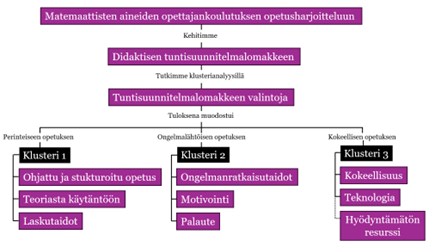
Opetusharjoittelun rooli opettajankoulutuksessa on merkittävä, sillä oppituntien suunnittelu, toteuttaminen ja reflektio ovat keskeinen osa opetustyötä. Kehitimme opetusharjoittelua varten didaktisen tuntisuunnitelmalomakkeen, joka tarjoaa opettajaopiskelijoille erilaisia vaihtoehtoja opetuksen toteuttamiseen ja pyrkii siten monipuolistamaan opetusharjoittelussa pidettyjä oppitunteja. Tutkimukseen osallistuneet matemaattisten aineiden aineenopettajaopiskelijat (N=18) luovuttivat tutkimusta varten kaikki pedagogisen opiskeluvuoden aikana tehdyt tuntisuunnitelmat. Analysoimme klusterianalyysin keinoin, millaisia vaihtoehtoja opettajaopiskelijat lomakkeesta tyypillisesti valitsevat. Tulosten mukaan tuntisuunnitelmat jakautuivat yleisyysjärjestyksessä kolmeen pääkategoriaan: perinteiset, ongelmalähtöiset ja kokeelliset oppitunnit. Koska perinteisen oppitunnin piirteitä korostavia suunnitelmia laaditaan opetusharjoittelussa turhankin paljon, kyseisten suunnitelmien määrää pienentämällä voisi opetusharjoittelukokemusta monipuolistaa. Didaktisen tuntisuunnitelmalomakkeen instrumentilla on potentiaalia tutkia opetusharjoittelua systemaattisesti, ja sitä voidaan laajentaa myös muihin opettajankoulutusyksiköihin ja oppiaineisiin.
STEM subject teacher training: What kind of lessons are planned in teaching practice?
Abstract: The role of teaching practice in teacher education is significant, as lesson planning, implementation and reflection are a central part of teaching work. We developed a didactic lesson plan form for teaching practice, which offers teacher students different options for implementing teaching and thus aims to diversify the lessons held in teaching practice. The mathematics subject teacher students who participated in the study (N=18) submitted all lesson plans made during the pedagogical study year for the study. We analyzed using cluster analysis what options student teachers typically choose from the form. According to the results, the lesson plans were divided into three main categories in order of prevalence: traditional, problem-based and experimental lessons. Since majority of the plans emphasize the features of a traditional lesson, the teaching practice experience could be diversified by reducing the number of such plans. The didactic lesson plan form instrument has the potential to systematically study teaching practice and can also be extended to other teacher education units and subjects.
Keywords: Teacher education, teaching practice, lesson plans, STEM-subjects, assessment and development
References
Abadi, A., & Ekawati, R. (2018). Redesigning preservice mathematics teacher’s lesson plan by using productive pedagogies framework. Journal of Engineering Science and Technology, 13(5), 1376-1383. https://jestec.taylors.edu.my/Vol%2013%20issue%205%20May%202018/13_5_18.pdf
Appleton, K., & Kindt, I. (2002). Beginning elementary teachers' development as teachers of science. Journal of Science Teacher Education, 13(1), 43-61. https://doi.org/10.1023/A:1015181809961
Arifin, S., Setyosari, P., Sa'dijah, C., & Kuswandi, D. (2020). The effect of problem based learning by cognitive style on critical thinking skills and student retention. Journal of Technology and Science Education, 10(2), 271-281. https://doi.org/10.3926/jotse.790
Bailey, K. M. (1996). The best-laid plans: Teachers’ in-class decisions to depart from their lesson plans. Teoksessa K. M. Bailey, & D. Nunan (Toim.), Voices from the language classroom: Qualitative research in second language classrooms (s. 15-40). Cambridge University Press.
Blömeke, S., & Kaiser, G. (2017). Understanding the development of teachers’ professional competencies as personally, situationally and socially determined. Teoksessa D. J. Clandinin, J. Husu, S. Blömeke, & G. Kaiser (Toim.), International handbook of research on teacher education (s. 783-802). SAGE Publications. https://doi.org/10.4135/9781526402042.n45
Bridges, C. C. (1966). Hierarchical cluster analysis. Psychological Reports, 18(3), 851-854. https://doi.org/10.2466/pr0.1966.18.3.851
Bürger, N., Engelmann, K., Schultze, L., Schlamelcher, M., & Wecker, C. (2026). The role of teacher characteristics for instructional quality: A meta-analysis. Learning and Individual Differences, 127, 102802. https://doi.org/10.1016/j.lindif.2025.102802
Cevikbas, M., König, J., & Rothland, M. (2024). Empirical research on teacher competence in mathematics lesson planning: Recent developments. ZDM–Mathematics Education, 56(1), 101-113. https://doi.org/10.1007/s11858-023-01487-2
Chizhik, E. W., & Chizhik, A. W. (2018). Using activity. The Teacher Educator, 53(1), 67-85. https://doi.org/10.1080/08878730.2017.1296913
Drost, B. R., & Levine, A. C. (2015). An analysis of strategies for teaching standards-based lesson plan alignment to preservice teachers. Journal of Education, 195(2), 37-47. https://doi.org/10.1177/002205741519500206
Eick, C. J., & Reed, C. J. (2002). What makes an inquiry‐oriented science teacher? The influence of learning histories on student teacher role identity and practice. Science Education, 83(3), 401-416. https://doi.org/10.1002/sce.10021
Everitt, B. S., Landau, S., Leese, M., & Stahl, D. (2011). Cluster analysis (5. painos). Wiley. https://doi.org/10.1002/9780470977811
Hair, J. F., Black, W. C., Babin, B. J., & Anderson, R. E. (2019). Multivariate data analysis (8. painos). Cengage Learning. https://eli.johogo.com/Class/CCU/SEM/_Multivariate%20Data%20Analysis_Hair.pdf
He, X., Norulhuda, I., & He, M. (2025). The effect of problem-based learning, cooperative learning, and discovery learning on mathematical problem-solving skill: A meta-analysis and systematic review. Pertanika Journal of Social Sciences and Humanities, 33(3), 1037-1058. https://doi.org/10.47836/pjssh.33.3.14
Hiebert, J. (2003). Teaching mathematics in seven countries: Results from the TIMSS 1999 video study. DIaNe Publishing. https://doi.org/10.1037/e610352011-003
John, P. D. (2006). Lesson planning and the student teacher: re-thinking the dominant model. Journal of Curriculum Studies, 38(4), 438-498. https://doi.org/10.1080/00220270500363620
Kansallinen opettajankoulutusfoorumi. (2025). Opettajankoulutus 2050: Suomalaisen opettajankoulutuksen visio. Helsingin yliopisto. https://helda.helsinki.fi/items/fe7d959f-de0e-4e22-8354-f59f7820eeba
Kaufman, L., & Rousseeuw, P. J. (1990). Finding groups in data: An introduction to cluster analysis. John Wiley & Sons.
Ko, E. (2012). What is your objective?: 'Preservice teachers' views and practice of instructional planning. International Journal of Learning, 18(7), 89-100. https://doi.org/10.18848/1447-9494/CGP/v18i07/47677
Kula, S., & Güzel, E. B. (2014). Misconceptions emerging in mathematics student teachers’ limit instruction and their reflections. Quality & Quantity, 48(6), 3355-3372. https://doi.org/10.1007/s11135-013-9960-6
König, J., Krepf, M., Bremerich-Vos, A., & Buchholtz, C. (2021). Meeting cognitive demands of lesson planning: Introducing the CODE-PLAN model to describe and analyze teachers’ planning competence. The Teacher Educator, 56(4), 466-487. https://doi.org/10.1080/08878730.2021.1932371
Leuders, T., Philipp, K., & Leuders, J. (2017). Diagnostic competence of mathematics teachers: Unpacking a complex construct in teacher education and teacher practice. Springer. https://doi.org/10.1007/978-3-319-66327-2
Lim, W., Son, J. W., & Kim, D. J. (2018). Understanding preservice teacher skills to construct lesson plans. International Journal of Science and Mathematics Education, 16(3), 519-538. https://doi.org/10.1007/s10763-016-9783-y
Metsäpelto, R. L., Poikkeus, A. M., Heikkilä, M., Husu, J., Laine, A., Lappalainen, K., Lähteenmäki, M., Mikkilä-Erdmann, M., Warinowski, A., Iiskala, T., Hangelin, S., Harmoinen, S., Holström, A., Kyrö-Ämmälä, O., Lehesvuori, S., Mankki, V., & Suvilehto, P. (2022). A multidimensional adapted process. Educational Assessment, Evaluation and Accountability, 34(2), 143-172. https://doi.org/10.1007/s11092-021-09373-9
Millar, R., & Abrahams, I. (2009). Practical work: making it more effective. School Science Review, 91(334), 59-64. http://www.gettingpractical.org.uk/documents/RobinSSR.pdf
Milligan, G. W., & Cooper, M. C. (1987). Methodology review: Clustering methods. Applied Psychological Measurement, 11(4), 329–354. https://doi.org/10.1177/014662168701100401
Opetushallitus. (2014). Perusopetuksen opetussuunnitelman perusteet. Opetushallitus. https://www.oph.fi/fi/koulutus-ja-tutkinnot/perusopetuksen-opetussuunnitelman-perusteet
Opetushallitus. (2019). Lukion opetussuunnitelman perusteet. Opetushallitus. https://www.oph.fi/sites/default/files/documents/lukion_opetussuunnitelman_perusteet_2019.pdf
Philipp, R. A. (2007). Mathematics teachers’ beliefs and affect. Teoksessa F. K. Lester (Toim.), Second handbook of research on mathematics teaching and learning (s. 257-315). Information Age Publishing.
Prabowo, A., Suryadi, D., Dasari, D., Juandi, D., & Junaedi, I. (2022). Learning obstacles in the making of lesson plans by prospective mathematics teacher students. Education Research International, 2022, Article 2896860. https://doi.org/10.1155/2022/2896860
Rasehorm, K. (2009). Opettajuuden kehittyminen. Teoksessa J. Lohivuori, P. Paananen, & L. Väkevä (Toim.), Musiikkikasvatus: Näkökulmia kasvatukseen, opetukseen ja tutkimukseen (s. 259-285). Suomen musiikkikasvatusseura FiSME. https://fisme.fi/wp-content/uploads/2017/08/Opetta-juuden-kehittyminen-Rasehorn.pdf
Sapkota, B., & Hayes, A. H. (2024). Preservice teachers' mathematical knowledge for teaching: Focus on lesson planning and reflection. School Science and Mathematics, 124(5), 323-339. https://doi.org/10.1111/ssm.12658
Schukajlow, S., Rakoczy, K., & Pekrun, R. (2017). Emotions and motivation in mathematics education: Theoretical considerations and empirical contributions. ZDM - Mathematics Education, 49(3), 307-322. https://doi.org/10.1007/s11858-017-0848-2
Shulman, L. E. (1986). Those who understand: Knowledge growth in teaching. Educational Researcher, 15(2), 4-14. https://doi.org/10.2307/1175860
Taylan, R. D. (2018). The relationship between pre-service mathematics teachers’ focus on student thinking in lesson analysis and lesson planning tasks. International Journal of Science and Mathematics Education, 16(2), 337-356. https://doi.org/10.1007/s10763-016-9775-y
Ulusoy, F., & İncikabi, L. (2023). Preservice mathematics teachers’ selection of curriculum resources in individual and group lesson planning processes. International Journal of Mathematical Education in Science and Technology, 54(4), 557-578. https://doi.org/10.1080/0020739X.2021.1958944
Van der Wal, L. G., & Jojo, Z. M. (2014). Exploring teaching strategies to attain high performance in grade eight mathematics: A case study of Chungcheongbuk province, South Korea. Mediterranean Journal of Social Sciences, 5(23), 1106-1112. http://dx.doi.org/10.5901/mjss.2014.v5n23p1106
Ward, J. H. (1963). Hierarchical grouping to optimize an objective function. Journal of the American Statistical Association, 58(301), 236-244. https://doi.org/10.1080/01621459.1963.10500845
Wijnia, L., Noordzij, G., Arends, L. R., Rikers, R. M., & Loyens, S. M. (2024). The effects of problem-based, project-based, and case-based learning on students’ motivation: A meta-analysis. Educational Psychology Review, 36(1), 1-38. https://doi.org/10.1007/s10648-024-09855-y
Woods, P. J., & Copur-Gencturk, Y. (2024). Examining the role of student-centered versus teacher-centered pedagogical approaches to self-directed learning through teaching. Teaching and Teacher Education, 138, Article 104415. https://doi.org/10.1016/j.tate.2023.104415
Downloads
Published
How to Cite
License
Copyright (c) 2026 Mika Koponen, Mikko Kesonen, Tomi Jaakkola

This work is licensed under a Creative Commons Attribution 4.0 International License.