
Teachers’ positioning in the early stages of STEAM-based school reform
DOI:
https://doi.org/10.31129/LUMAT.14.2.3246Keywords:
STEAM, In-service teachers, positioning, Schools, ReformAbstract
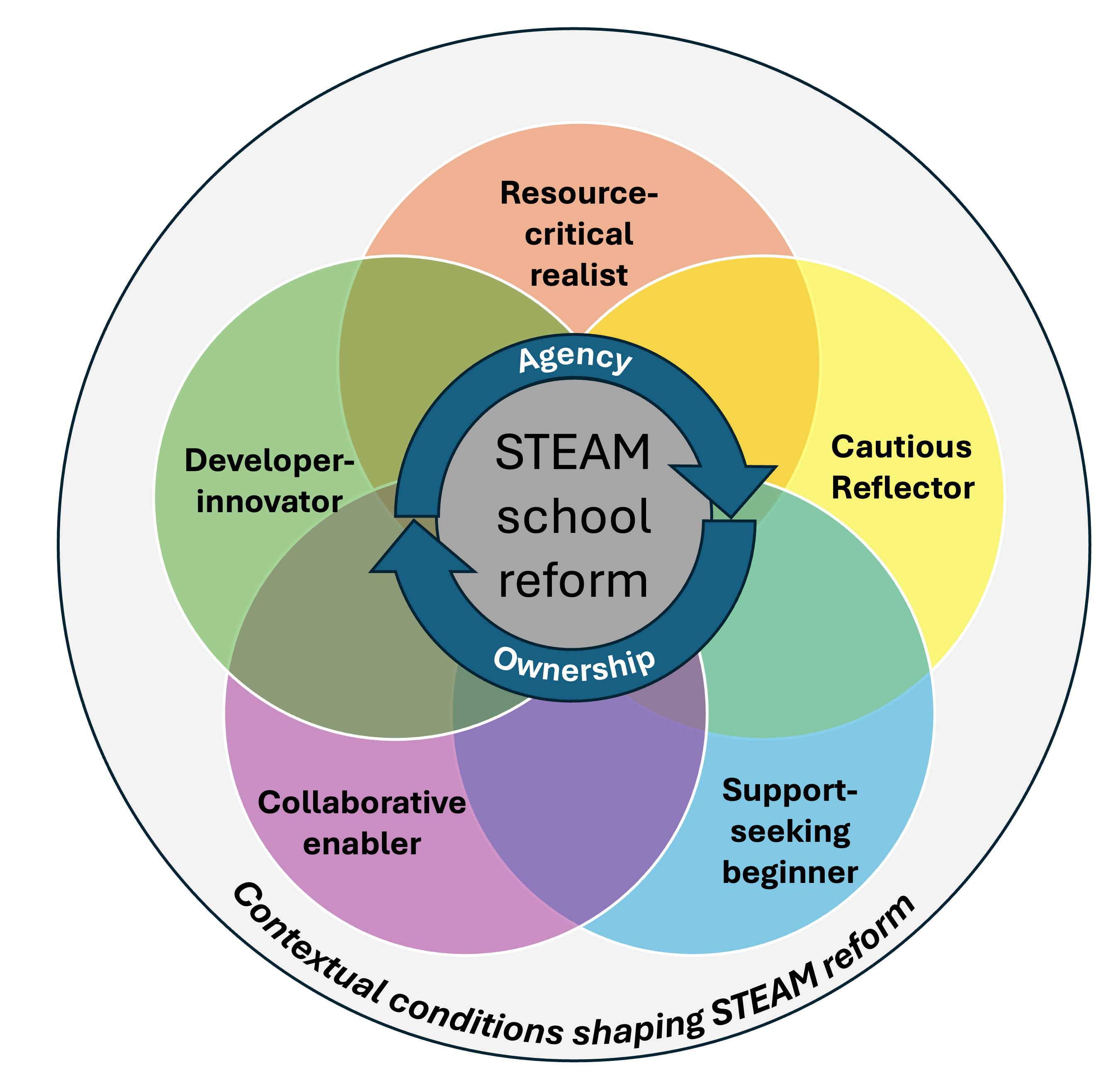
This qualitative case study in Finland examined how teachers position themselves toward STEAM education during the early stages of a whole‑school reform. Data was collected from primary and secondary subject teachers (N=30) using a questionnaire with open-ended questions and SWOT matrices. Through content analysis with a positioning lens and triangulated themes, we identified five narrative positions: resource‑critical realists, cautious reflectors, support-seeking beginners, collaborative enablers, and developer-innovators. Teachers may adopt overlapping positioning when they negotiate their agency and ownership towards the STEAM education approach in their school. Teachers valued STEAM’s potential for student engagement, transdisciplinary learning, and strengthening the school’s brand and profile, but highlighted time, material resources, suitable spaces, and curriculum or assessment alignment as key constraints. Participants without prior experience requested low‑threshold entry, concrete models, and mentoring, while experienced teachers emphasised peer support, leadership recognition, and opportunities to co‑design and scale practices. Findings suggest that successful STEAM reform in schools requires bottom‑up acknowledgment, strategic leadership, reserved time for co‑planning, and scaffolded professional development that builds a shared vision. We conclude that reforms should deliberately recognise and accommodate all positions, using them to facilitate support and pathways from STEAM’s potential to everyday practice.
References
Allen, C. D., & Penuel, W. R. (2015). Studying Teachers’ Sensemaking to Investigate Teachers’ Responses to Professional Development Focused on New Standards. Journal of Teacher Education, 66(2), 136–149. https://doi.org/10.1177/0022487114560646 DOI: https://doi.org/10.1177/0022487114560646
Belbase, S., Mainali, B. R., Kasemsukpipat, W., Tairab, H., Gochoo, M., & Jarrah, A. (2022). At the dawn of science, technology, engineering, arts, and mathematics (STEAM) education: Prospects, priorities, processes, and problems. International Journal of Mathematical Education in Science and Technology, 53(11), 2919–2955. https://doi.org/10.1080/0020739X.2021.1922943 DOI: https://doi.org/10.1080/0020739X.2021.1922943
Biesta, G., Priestley, M., & Robinson, S. (2015). The role of beliefs in teacher agency. Teachers and Teaching, 21(6), 624–640. https://doi.org/10.1080/13540602.2015.1044325 DOI: https://doi.org/10.1080/13540602.2015.1044325
Biesta, G., & Tedder, M. (2007). Agency and learning in the lifecourse: Towards an ecological perspective. Studies in the Education of Adults, 39(2), 132–149. https://doi.org/10.1080/02660830.2007.11661545 DOI: https://doi.org/10.1080/02660830.2007.11661545
Breiting, S. (2008). Mental Ownership and Participation for Innovation in Environmental Education and Education for Sustainable Development. In A. Reid, B. B. Jensen, J. Nikel, & V. Simovska (Eds), Participation and Learning (pp. 159–180). Springer Netherlands. https://doi.org/10.1007/978-1-4020-6416-6_10 DOI: https://doi.org/10.1007/978-1-4020-6416-6_10
Cathcart, S., Priestley, M., Priestley, A., & Rushton, E. A. C. (2026). Unravelling agency: A critical review of conceptualisations of agency for educational research, policy and practice. Review of Education, 14(1), e70131. https://doi.org/10.1002/rev3.70131 DOI: https://doi.org/10.1002/rev3.70131
Conradty, C., & Bogner, F. X. (2020). STEAM teaching professional development works: Effects on students’ creativity and motivation. Smart Learning Environments, 7(1), 26. https://doi.org/10.1186/s40561-020-00132-9 DOI: https://doi.org/10.1186/s40561-020-00132-9
Cook, K. L., Cox, R., Edelen, D., & Bush, S. B. (2025). Elementary Student Perspectives on STEAM Education. Education Sciences, 15(6), 689. https://doi.org/10.3390/educsci15060689 DOI: https://doi.org/10.3390/educsci15060689
Datnow, A. (2020). The role of teachers in educational reform: A 20-year perspective. Journal of Educational Change, 21(3), 431–441. https://doi.org/10.1007/s10833-020-09372-5 DOI: https://doi.org/10.1007/s10833-020-09372-5
Davies, B., & Harré, R. (1990). Positioning: The Discursive Production of Selves. Journal for the Theory of Social Behaviour, 20(1), 43–63. https://doi.org/10.1111/j.1468-5914.1990.tb00174.x DOI: https://doi.org/10.1111/j.1468-5914.1990.tb00174.x
Day, C., & Gu, Q. (2010). The New Lives of Teachers. Routledge. https://doi.org/10.4324/9780203847909 DOI: https://doi.org/10.4324/9780203847909
Day, D., & Kjaerbeck, S. (2013). ‘Positioning’ in the conversation analytic approach. Narrative Inquiry, 23(1), 16–39. https://doi.org/10.1075/ni.23.1.02day DOI: https://doi.org/10.1075/ni.23.1.02day
Deppermann, A. (2013). Editorial: Positioning in narrative interaction. Narrative Inquiry, 23(1), 1–15. https://doi.org/10.1075/ni.23.1.01dep DOI: https://doi.org/10.1075/ni.23.1.01dep
Drew, V., Priestley, M., & Michael, M. K. (2016). Curriculum development through critical collaborative professional enquiry. Journal of Professional Capital and Community, 1(1), 92–106. https://doi.org/10.1108/JPCC-09-2015-0006 DOI: https://doi.org/10.1108/JPCC-09-2015-0006
Eteläpelto, A., Vähäsantanen, K., Hökkä, P., & Paloniemi, S. (2013). What is agency? Conceptualizing professional agency at work. Educational Research Review, 10, 45–65. https://doi.org/10.1016/j.edurev.2013.05.001 DOI: https://doi.org/10.1016/j.edurev.2013.05.001
European Commission. (2020). European Skills Agenda for sustainable competitiveness, social fairness and resilience. Publications Office of the European Union.
Finnish National Agency for Education. (2016). National core curriculum for basic education 2014. Finnish National Agency for Education.
Gouëdard, P., Pont, B., Hyttinen, S., & Huang, P. (2020). Curriculum reform: A literature review to support effective implementation (OECD Education Working Papers No. 239; OECD Education Working Papers, Vol. 239). https://doi.org/10.1787/efe8a48c-en DOI: https://doi.org/10.1787/efe8a48c-en
Graham, M. (2025). Maker spaces, walking, and mentorship as ways to develop transversal skills. Arts Education Policy Review, 126(4), 277–287. https://doi.org/10.1080/10632913.2025.2478990 DOI: https://doi.org/10.1080/10632913.2025.2478990
Harris, A., & De Bruin, L. R. (2018). Secondary school creativity, teacher practice and STEAM education: An international study. Journal of Educational Change, 19(2), 153–179. https://doi.org/10.1007/s10833-017-9311-2 DOI: https://doi.org/10.1007/s10833-017-9311-2
Henriksen, D. (2014). Full STEAM Ahead: Creativity in Excellent STEM Teaching Practices. STEAM, 1(2), 1–9. https://doi.org/10.5642/steam.20140102.15 DOI: https://doi.org/10.5642/steam.20140102.15
Herro, D., & Quigley, C. (2017). Exploring teachers’ perceptions of STEAM teaching through professional development: Implications for teacher educators. Professional Development in Education, 43(3), 416–438. https://doi.org/10.1080/19415257.2016.1205507 DOI: https://doi.org/10.1080/19415257.2016.1205507
Hughes, B. S., Corrigan, M. W., Grove, D., Andersen, S. B., & Wong, J. T. (2022). Integrating arts with STEM and leading with STEAM to increase science learning with equity for emerging bilingual learners in the United States. International Journal of STEM Education, 9(1), 58. https://doi.org/10.1186/s40594-022-00375-7 DOI: https://doi.org/10.1186/s40594-022-00375-7
Kang, N.-H. (2019). A review of the effect of integrated STEM or STEAM (science, technology, engineering, arts, and mathematics) education in South Korea. Asia-Pacific Science Education, 5(1), 6. https://doi.org/10.1186/s41029-019-0034-y DOI: https://doi.org/10.1186/s41029-019-0034-y
Ketelaar, E., Beijaard, D., Boshuizen, H. P. A., & Den Brok, P. J. (2012). Teachers’ positioning towards an educational innovation in the light of ownership, sense-making and agency. Teaching and Teacher Education, 28(2), 273–282. https://doi.org/10.1016/j.tate.2011.10.004 DOI: https://doi.org/10.1016/j.tate.2011.10.004
Kim, K., Lee, K., & Kwon, O. N. (2024). A Systematic Literature Review of the Empirical Studies on STEAM Education in Korea: 2011–2019. In Y. Li, Z. Zeng, & N. Song (Eds), Disciplinary and Interdisciplinary Education in STEM (pp. 103–117). Springer Nature Switzerland. https://doi.org/10.1007/978-3-031-52924-5_6 DOI: https://doi.org/10.1007/978-3-031-52924-5_6
Kim, Y.-H., & Na, S.-I. (2022). Using structural equation modelling for understanding relationships influencing the middle school technology teacher’s attitudes toward STEAM education in Korea. International Journal of Technology and Design Education, 32(5), 2495–2526. https://doi.org/10.1007/s10798-021-09708-z DOI: https://doi.org/10.1007/s10798-021-09708-z
Konopasky, A. W., & Sheridan, K. M. (2016). Towards a Diagnostic Toolkit for the Language of Agency. Mind, Culture, and Activity, 23(2), 108–123. https://doi.org/10.1080/10749039.2015.1128952 DOI: https://doi.org/10.1080/10749039.2015.1128952
LaPointe, K. (2010). Narrating career, positioning identity: Career identity as a narrative practice. Journal of Vocational Behavior, 77(1), 1–9. https://doi.org/10.1016/j.jvb.2010.04.003 DOI: https://doi.org/10.1016/j.jvb.2010.04.003
Liao, C. (2016). From Interdisciplinary to Transdisciplinary: An Arts-Integrated Approach to STEAM Education. Art Education, 69(6), 44–49. https://doi.org/10.1080/00043125.2016.1224873 DOI: https://doi.org/10.1080/00043125.2016.1224873
Lipponen, L., & Kumpulainen, K. (2011). Acting as accountable authors: Creating interactional spaces for agency work in teacher education. Teaching and Teacher Education, 27(5), 812–819. https://doi.org/10.1016/j.tate.2011.01.001 DOI: https://doi.org/10.1016/j.tate.2011.01.001
Marshall, B., & Drummond, M. J. (2006). How teachers engage with Assessment for Learning: Lessons from the classroom. Research Papers in Education, 21(2), 133–149. https://doi.org/10.1080/02671520600615638 DOI: https://doi.org/10.1080/02671520600615638
Merriam, S. B., & Tisdell, E. J. (2016). Qualitative research: A guide to design and implementation (Fourth edition). John Wiley & Sons.
Milara, I. S., Pitkänen, K., Laru, J., Iwata, M., Orduña, M. C., & Riekki, J. (2020). STEAM in Oulu: Scaffolding the development of a Community of Practice for local educators around STEAM and digital fabrication. International Journal of Child-Computer Interaction, 26, 100197. https://doi.org/10.1016/j.ijcci.2020.100197 DOI: https://doi.org/10.1016/j.ijcci.2020.100197
Ministry of Education and Culture. (2023). Finnish National STEM Strategy and Action Plan: Experts in natural sciences, technology and mathematics in support of society’s welfare and growth. Publications of the Ministry of Education and Culture, Finland.
OECD. (2018). The Future of Education and Skills: Education 2030 (OECD Education Policy Perspectives No. 98; OECD Education Policy Perspectives, Vol. 98). OECD. https://doi.org/10.1787/54ac7020-en DOI: https://doi.org/10.1787/54ac7020-en
Perignat, E., & Katz-Buonincontro, J. (2019). STEAM in practice and research: An integrative literature review. Thinking Skills and Creativity, 31, 31–43. https://doi.org/10.1016/j.tsc.2018.10.002 DOI: https://doi.org/10.1016/j.tsc.2018.10.002
Pierce, J. L., Kostova, T., & Dirks, K. T. (2001). Toward a Theory of Psychological Ownership in Organizations. The Academy of Management Review, 26(2), 298. https://doi.org/10.2307/259124 DOI: https://doi.org/10.2307/259124
Pieters, J., Voogt, J., & Pareja Roblin, N. (Eds). (2019). Collaborative Curriculum Design for Sustainable Innovation and Teacher Learning. Springer International Publishing. https://doi.org/10.1007/978-3-030-20062-6 DOI: https://doi.org/10.1007/978-3-030-20062-6
Poulton, P. (2020). Teacher agency in curriculum reform: The role of assessment in enabling and constraining primary teachers’ agency. Curriculum Perspectives, 40(1), 35–48. https://doi.org/10.1007/s41297-020-00100-w DOI: https://doi.org/10.1007/s41297-020-00100-w
Quigley, C. F., Herro, D., & Jamil, F. M. (2017). Developing a Conceptual Model of STEAM Teaching Practices. School Science and Mathematics, 117(1–2), 1–12. https://doi.org/10.1111/ssm.12201 DOI: https://doi.org/10.1111/ssm.12201
Reinius, H., Hakkarainen, K., Juuti, K., & Korhonen, T. (2024). Teachers’ perceived opportunity to contribute to school culture transformation. Journal of Educational Change, 25(2), 369–391. https://doi.org/10.1007/s10833-023-09496-4 DOI: https://doi.org/10.1007/s10833-023-09496-4
Schleicher, A. (2018). World Class: How to Build a 21st-Century School System. OECD. https://doi.org/10.1787/9789264300002-en DOI: https://doi.org/10.1787/9789264300002-en
Stevenson, M., Hedberg, J. G., O’Sullivan, K.-A., & Howe, C. (2016). Leading learning: The role of school leaders in supporting continuous professional development. Professional Development in Education, 42(5), 818–835. https://doi.org/10.1080/19415257.2015.1114507 DOI: https://doi.org/10.1080/19415257.2015.1114507
Thomas, K., & Huffman, D. (Eds). (2020). Challenges and Opportunities for Transforming From STEM to STEAM Education: IGI Global. https://doi.org/10.4018/978-1-7998-2517-3 DOI: https://doi.org/10.4018/978-1-7998-2517-3
Toom, A., Pyhältö, K., Pietarinen, J., & Soini, T. (2021). Professional Agency for Learning as a Key for Developing Teachers’ Competencies? Education Sciences, 11(7), 324. https://doi.org/10.3390/educsci11070324 DOI: https://doi.org/10.3390/educsci11070324
Vangrieken, K., Meredith, C., Packer, T., & Kyndt, E. (2017). Teacher communities as a context for professional development: A systematic review. Teaching and Teacher Education, 61, 47–59. https://doi.org/10.1016/j.tate.2016.10.001 DOI: https://doi.org/10.1016/j.tate.2016.10.001
Voogt, J., Laferrière, T., Breuleux, A., Itow, R. C., Hickey, D. T., & McKenney, S. (2015). Collaborative design as a form of professional development. Instructional Science, 43(2), 259–282. https://doi.org/10.1007/s11251-014-9340-7 DOI: https://doi.org/10.1007/s11251-014-9340-7
Yakman, G., & Lee, H. (2012). Exploring the Exemplary STEAM Education in the U.S. as a Practical Educational Framework for Korea. Journal of the Korean Association for Science Education, 32(6), 1072–1086. https://doi.org/10.14697/jkase.2012.32.6.1072 DOI: https://doi.org/10.14697/jkase.2012.32.6.1072
Yim, I. H. Y., Su, J., & Wegerif, R. (2025). STEAM in practice and research in primary schools: A systematic literature review. Research in Science & Technological Education, 43(4), 1065–1089. https://doi.org/10.1080/02635143.2024.2440424 DOI: https://doi.org/10.1080/02635143.2024.2440424
Yin, R. K. (2018). Case study research and applications: Design and methods (Sixth edition). SAGE.
Downloads
Additional Files
Published
How to Cite
Issue
Section
Categories
License
Copyright (c) 2026 Anssi Salonen, Päivikki Liukkonen, Anne Posti, Kari Sormunen, Lasse Eronen, Sirpa Kokko

This work is licensed under a Creative Commons Attribution 4.0 International License.